

My story begins in second grade. It was 1982. School required the shot, so my mother had scheduled the date my uncle was to pick me up after school to take me to get it. But there was a problem. I didn’t want it, so even though my mother told me to not get on the bus and instead go with my uncle, I slipped through the crowd, avoided him, and got on the bus. I was relieved that I was safe, watching my uncle search the crowd for me as I rode home, safe from the impending doom of a needle. I thought I had outsmarted the adults, but my mother simply rescheduled the appointment and picked me up in the middle of my school day, so I had no way to escape. I was seven. As a child, I had no legal capacity to consent to what was about to happen to my body, and no standing to refuse it. The adults in the room had decided it was going to happen whether I liked it or not.
So I fought. It took several adults to hold me down, kicking and screaming, putting up the strongest fight my wild little seven-year-old body could muster. My whole body was clenched when the needle went in. It did not go into a child sitting still with soft, relaxed muscle. It went into a muscle contracted by an unwilling child fighting with everything she had to make her position clear: an emphatic no. Because I was flailing to that degree, it took several adults acting in concert to restrain me, and the needle went into that tight left glute instead of my arm.
A contracted muscle does not receive an intramuscular injection the way a relaxed one does. The tissue cannot give. This matter of basic physiological difference became the mechanical origin of everything that follows in this account. This event was not one adult acting alone. It was several people, acting together, using coordinated physical force to overcome a child’s continuous, physical refusal, in order to complete a bodily invasion she had not consented to and had no legal power to consent to. In the language the law actually uses for that combination of facts (a nonconsensual touching accomplished through force, by multiple actors acting in concert) that is what a battery is, regardless of the object doing the touching or the sanctioned reason behind it. A mandate can make an act lawful on paper, but it does not make it non-forcible, and it does not make the child who experienced it consenting.
The pain the next day was the immediate cost. I could barely walk. I could barely sit. Navigating school after that was genuinely difficult, and I remember it (just like the day I was held down) vividly to this day. But that room, several grown people holding down a child who had already said no with her whole body, was only the first harm. The longer harm is what that morning became, long after the soreness of those first few days had cleared.
Over the following years, that trauma produced multifocal lesions of heterotopic ossification in that same left glute: benign masses made up of BB-sized pieces of bone, formed where bone does not belong. It was around twelve years later, at nineteen, that I noticed the lumps. They had gotten big enough that I could no longer sit comfortably on my left side. For years, I lived at an angle. School desks, cars, dinner chairs: every one of them asked something of the left side that the left side could no longer give. Discomfort was the weather of my days. I sat on my right because the left would not allow an ordinary chair, and the imbalance eventually reached my left sacrum and the musculature supporting the SI joint.
What happened in my own body follows a documented clinical pattern. Heterotopic ossification, also called myositis ossificans, is bone forming inside muscle tissue where it should not, and it is a well-established complication of significant muscle trauma, particularly trauma involving a hematoma. The gluteal muscles are repeatedly identified in the orthopedic literature as the single most common site for it to occur.1 An intramuscular injection forced into a muscle that is clenched and fighting, rather than relaxed, is exactly the kind of tissue trauma this literature describes as a trigger. The pattern is documented closely enough to my own circumstances that a published case series specifically describes permanent heterotopic ossification forming at the injection site following intramuscular DTP immunization.2 That study concerns children with a rare genetic condition in which this reaction is especially pronounced, so I am not citing it to claim that diagnosis for myself, only to establish that intramuscular DTP injection is a recognized, published trigger for heterotopic ossification at the injection site, not a mechanism I am proposing on my own authority.
A related, though mechanistically distinct, pattern makes the broader point even more plainly. In cats, delayed injection-site pathology takes the form of injection-site sarcoma, linked since the early 1990s to chronic inflammation at the vaccination site, with researchers identifying aluminum adjuvant residue directly inside the tumor tissue itself.3 Veterinary medicine took that finding seriously enough to change practice: vaccines are now given in the distal limb specifically so that if a sarcoma develops, amputation can still achieve clean margins.4 Feline and human injection-site injuries are not the same disease, but the principle veterinary medicine acted on is the one I am asking human medicine to adopt: a delayed, local reaction to an injection is a known and trackable risk, worth designing protocol around, not an inconvenience to be dismissed because it takes years to surface. That is the standard of care I am asking human medicine, and the law that governs it, to rise to meet.
I eventually reached a point where the only way forward was to cut the lesions out of myself and pay for that cutting. Elective, they call it, as if choosing surgery after decades of pain were a luxury.
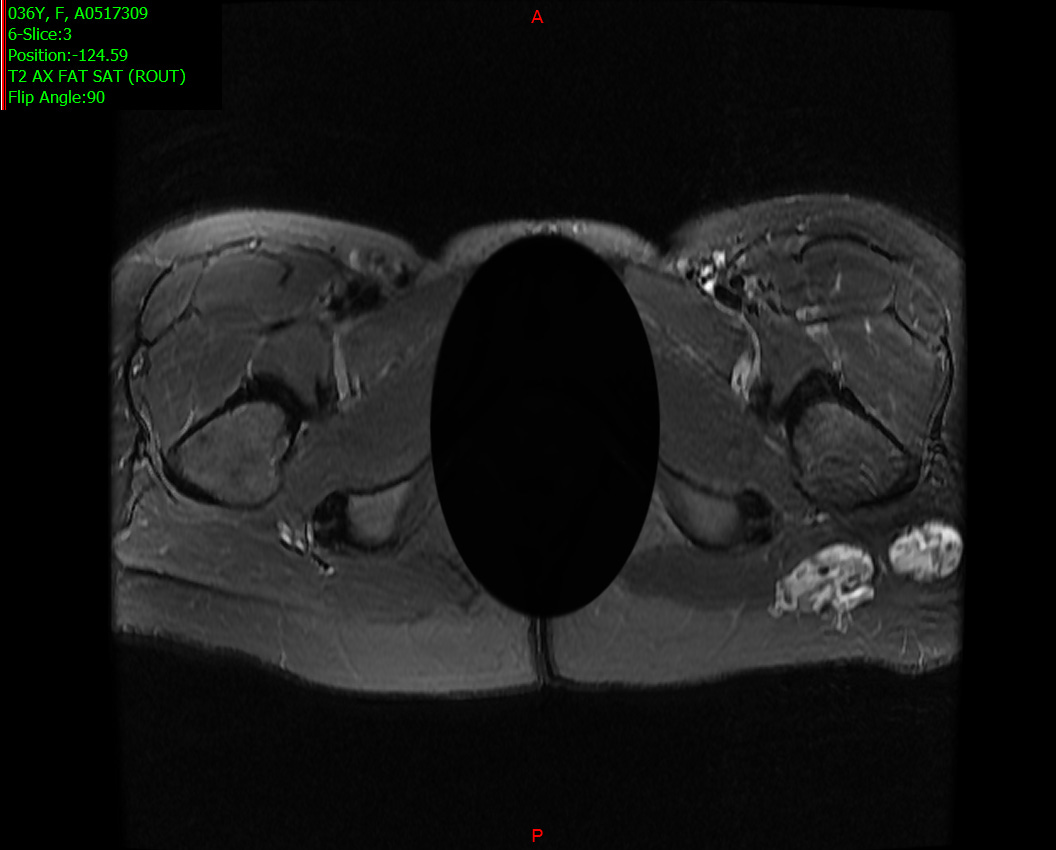
In 2012 I paid for the MRI. The film is dated February 24. It shows a cluster of bright masses inside the left gluteal muscle, darker mineralized foci inside the brightness, more than one lesion, stacked in the place the needle went.

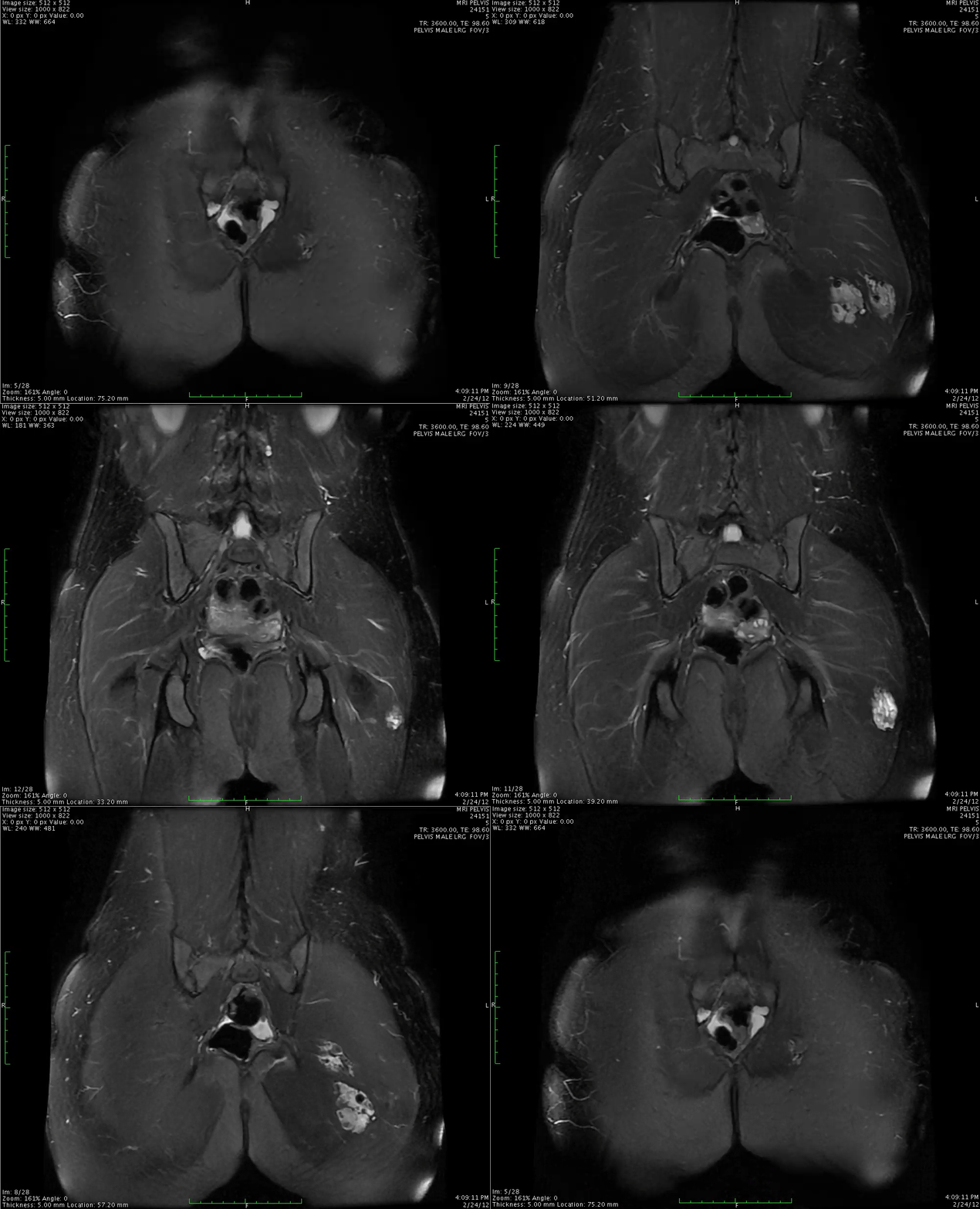
Above: MRI, left gluteal muscle, February 24, 2012. The animated sequence steps through consecutive axial (cross-sectional) slices; the bright, irregular masses visible on the right side of the frame are the lesions described above.
Below: A second axial slice, at a different level than the animated sequence, showing two of the three lesions.
I paid for the surgery too. Both for the cost of the surgeon, and the time off from work (as an independent consultant, I did not have paid time off, any days I don't work, are days without any income) and dealing with the pain of being cut open and trying to walk again in recovery after the surgery. What remains is still in me as added complications from all this: a hypermobile SI joint, and swollen lymph nodes along the back that are aggravated if massaged. In the literature, those kinds of lumps are called “back mice”.5 I live with the aftermath of a decision made against my will when I was a child, carried out by several adults acting together, whose consequences neither the medicine of the time nor the law since has had a place to fully record, to fully hear, or to fully remediate.
That history puts me in a precise, and precisely unfortunate, place in American law. The 1986 National Childhood Vaccine Injury Act created the National Vaccine Injury Compensation Program (VICP). Under the statute that still governs it, for a vaccine given before October 1, 1988, a petition had to be filed by January 31, 1991, and no petition could be filed at all if the first symptom or manifestation had appeared more than 36 months after the shot was given.6 For vaccines given after that date, the ordinary rule is a petition filed within three years of the first symptom or significant aggravation, or the manifestation window closes and the claim closes with it.7 The clock runs from manifestation. It does not wait for diagnosis, for a physician to connect a lesion to a needle, or for an MRI.
My MRI is dated thirty years after the shot. Both the 1991 filing deadline and the 36-month manifestation window for pre-1988 vaccines had already closed before those masses had finished becoming visible enough to name. Because of that procedural deadline, I am outside the “official” count of those injured in 1982. I am outside the count of those who filed a claim in the injury program. The civil path and the administrative path are both closed to me, and have been closed to me since 1985, roughly nine years before I even had a lump to point to.
The reason I am explaining this personal misfortune sitting outside the system’s design is not to elicit pity. It is to shed light on this glaringly obvious failure by design. VICP’s own published data tell the same story at scale: from the program’s start through the most recent public reporting, roughly one third of the claims that reach a decision are compensated and roughly two-thirds are denied, a ratio that has held for decades.8 Separately, the government’s own contracted research on the underlying reporting system, the Vaccine Adverse Event Reporting System (VAERS), states plainly that adverse events following vaccination are common but substantially underreported, with the report’s own background figure citing less than one percent of adverse events reaching the FDA at all.9 That specific number is a background claim in that report rather than a rigorously derived statistic, and it’s important to note that distinction. What it does establish, on the government’s own authority, is that VAERS as currently designed catches a small fraction of what actually happens. A passive reporting system built to catch acute reactions in the days after a shot was never built to catch a mass that takes twelve years to become a lump you can feel.
So I ask the questions the system’s closed door does not answer.
How many others developed masses at an injection site after the timetable for a claim had already expired? How many tumors and nodules presented in people for whom no one ever named the shot as the origin? How many granulomatous responses, mineralized lesions, and later diseases at the site of an adjuvanted injection were attributed to something else, or to nothing? How many recipients knew their own bodies, and how many parents knew their own children, while physicians and pediatricians set that knowledge aside? How many people injured before 1986 never filed, because there was nothing yet to file, and carried the rest of their lives in silence? How many died with no next of kin left to speak for them?
Some of this is not unknowable. Of the claims that survive long enough to reach a decision under the current program, roughly two out of three are denied, a ratio that has held for decades. That is the answer available for the people whose claims made it far enough to be counted at all. It says nothing about the people this account has already described: the ones the clock closed out before a claim could ever be filed.
Each of those questions is a person. A chair they could not sit in. A doctor’s denial. A form they could not finish in time, or could not finish at all. Statisticians gather that absence under a phrase: the underreporting factor. Under the percentage are lives, each with a duration of suffering. That is the part of the system I see as cold: it renders lives into a rounding error to argue over, rather than stories to listen to.
What Real Remediation Requires
The more popular debate has existed primarily in the area about whether vaccination itself should be mandated (childhood schedule), optional (shared decision making), or refused (personal, medical or religious exemption). That is a separate and, I think, later question.
The question I raise for readers in this article front and center is an important one. One I’d argue, that is harder to dismiss…
Does a compensation system that structurally cannot hear injuries which take years to declare themselves meet the basic requirement of due process for the people it mandates to take the risk in the first place?
I don’t think it has, as currently built, and I don’t think fixing that requires resolving the vaccine debate at all. It requires fixing the clock.
Concretely, that means:
A statute of limitations that runs from diagnosis and causal attribution, not from the date of the shot. An injury that cannot be identified as an injury for a decade cannot be timely filed under a rule that expects it within three years of administration. The clock should start when a competent medical finding first links the injury to the vaccine, not before.
A retroactive filing window for every claim closed by a clock that ran out before the injury was visible. This includes pre-1988 injuries like mine, and it includes any later injury whose three-year window lapsed before a diagnosis existed to file on.
Active, long-term pharmacovigilance at the injection site itself, tracking local pathology for years, not the weeks or months current safety monitoring is built around. Veterinary medicine already does a version of this for cats. Human medicine should not lag behind the standard set for animals.
An explicit off-table category for delayed, local, slow-developing injuries, reviewed on their own evidentiary terms rather than measured against a table built for injuries that announce themselves on schedule.
A guaranteed right to a hearing, regardless of when the injury became evident, so that no person’s claim is dismissed on timing alone before its merits are ever examined.
None of this is even an argument about whether or not vaccines are unsafe as a category. It asks the system that adjudicates the harms it already acknowledges exist to actually be able to hear all of them, not just the ones considerate enough to arrive within this (ridiculously short and extremely arbitrary) thirty-six month window of claim opportunity provided.
Due process is not a courtesy the state extends when convenient. It is an inalienable right enshrined in the Constitution of the United States, and it carries no exception for injuries that take their time. Every time a person is foreclosed from a hearing before their claim has ever been weighed on its merits, the state has deviated from that guarantee, however orderly the paperwork around that foreclosure looks.
The design's trade-off is not hidden. It is acknowledged outright, in the Act's own history and in the Supreme Court's reading of it. The Supreme Court itself, in Bruesewitz v. Wyeth (2011), described the arrangement in exactly these terms: a “quid pro quo, designed to stabilize the vaccine market,” in which Congress traded significant tort-liability protection for manufacturers for a federally administered compensation program in its place.10 That is the system working as designed, confirmed by the institution that upheld it. When the compensation side of that trade closes its doors to people like me before an injury is even visible, what remains standing is the liability shield alone: a manufacturing interest protected from suit, and a citizen with nowhere left to go. That is not a neutral administrative gap. It is corporatism in plain form, nation-state power and private manufacturing power arriving at an arrangement in which a citizen’s constitutional right to be heard becomes the cost absorbed on one side of the ledger. The battery done to my body as a child and the door closed on me as an adult are not two separate grievances. They are two harms produced by the same design, one completed by force in a room, the other completed by a clock no room could reach.
I am still here. The lesions had a date on an MRI. The law had already finished with me nine years before that date existed. As a result, I am uncounted. I am unseen. I am unheard. I am unreported, not because nothing happened to me, but because the system was never built to notice what happens on my timeline.
I am speaking because silence is how the uncounted stay uncounted. A just society does not get to decide in advance which injuries it will notice. If even one child is harmed by a mandate and left with no forum to be heard, healed, or made whole, that failure is not the child’s, or the parents, or the doctors. It is the state’s, and it is a constitutional one. The measure of a just compensation system is not how well it serves the injuries that arrive on schedule. It is whether it has any answer at all for the ones that don’t.
Footnotes
Myositis ossificans as a form of heterotopic ossification resulting from direct trauma or intramuscular hematoma, with the gluteal muscles among the most common locations: https://www.orthobullets.com/pathology/8042/myositis-ossificans ; general clinical overview: https://radsource.us/myositis-ossificans/ ; https://en.wikipedia.org/wiki/Myositis_ossificans; “Aluminum adjuvants of vaccines injected into the muscle: Normal fate, pathology and associated disease,” Toxicology, summarized at https://pubmed.ncbi.nlm.nih.gov/26948677/
Rogers JG, Geho WB. "Permanent heterotopic ossification at the injection site after diphtheria-tetanus-pertussis immunizations in children who have fibrodysplasia ossificans progressiva." Study population is children with FOP, a rare genetic disorder; cited here only to establish intramuscular DTP injection as a documented trigger for injection-site heterotopic ossification, not to claim an FOP diagnosis: https://pubmed.ncbi.nlm.nih.gov/7752003/
Hendrick MJ, Goldschmidt MH, Shofer FS, Wang YY, Somlyo AP. “Postvaccinal sarcomas in the cat: epidemiology and electron probe microanalytical identification of aluminum.” Cancer Research 52 (1992): 5391-5394, cited in the ABCD clinical guideline: https://www.abcdcatsvets.org/guideline-for-feline-injection-site-sarcoma/ ; Hendrick MJ, Dunagan CA, “Focal necrotizing granulomatous panniculitis associated with subcutaneous injection of rabies vaccine in cats and dogs,” JAVMA 198 (1991): 304-305, same source.
American Animal Hospital Association, “Update on Feline Injection-Site Sarcomas,” summarizing the Vaccine-Associated Feline Sarcoma Task Force’s distal-limb injection recommendation: https://www.aaha.org/resources/2020-aahaaafp-feline-vaccination-guidelines/update-injection-site-sarcoma/
WWhat are back mice? By the Medical Advisory Board https://www.droracle.ai/articles/252947/what-are-back-mice
42 U.S.C. § 300aa-16(a)(1), full text: https://www.law.cornell.edu/uscode/text/42/300aa-16 ; filing deadline confirmed by HRSA’s own program history: https://www.hrsa.gov/vaccine-compensation/about
42 U.S.C. § 300aa-16(a)(2)-(3), same link as above.
Summary of HRSA’s own monthly VICP data reports through January 2018, showing roughly 5,825 claims compensated against 11,113 denied of claims reaching decision: https://vaccinelaw.com/latest-statistics-on-vaccine-injury-compensation-claims/ ; current monthly figures are published directly by HRSA at https://www.hrsa.gov/vaccine-compensation/data
Lazarus R. “Electronic Support for Public Health – Vaccine Adverse Event Reporting System (ESP:VAERS),” Final Report to AHRQ/HHS (2011), stating adverse events are “common but underreported, with less than one percent reported to the Food and Drug Administration (FDA)”: https://digital.ahrq.gov/sites/default/files/docs/publication/r18hs017045-lazarus-final-report-2011.pdf
Bruesewitz v. Wyeth LLC, 562 U.S. 223, 229 (2011) (describing the Act’s design-defect immunity as “the quid pro quo” for a stabilized vaccine market, in exchange for “significant tort-liability protections for vaccine manufacturers”). Discussed at https://www.theregreview.org/2011/04/05/us-supreme-court-rules-in-favor-of-preemption-for-vaccine-injury-lawsuits/ and https://www.druganddevicelawblog.com/2022/12/terrible-decision-contravenes-the-vaccine-acts-purpose-and-would-gut-its-protections.html