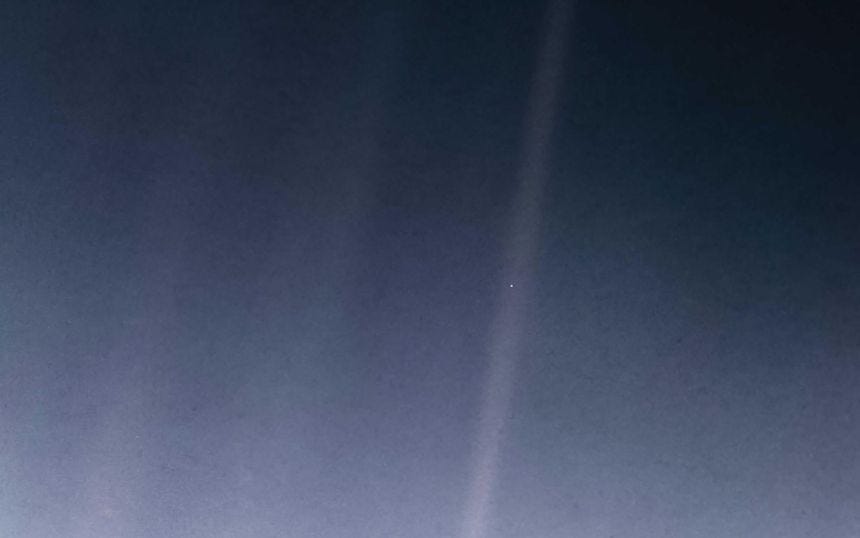
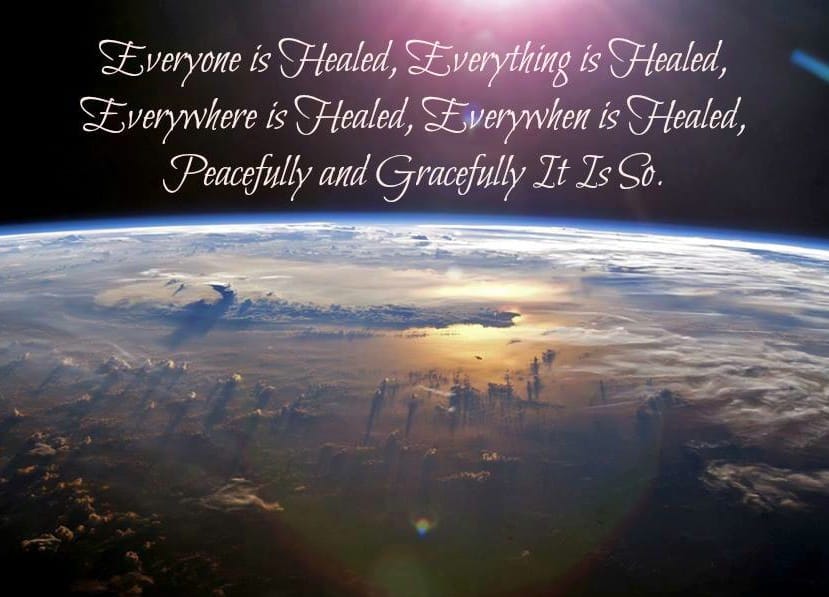
The pale blue dot. A miraculous world whirls like a dervish around a star, and everything we’ve ever been, this us, has resided on the wonder of a world longer than there was language to describe it. The magic of this marble might be lost on many, while millions are mired in humandom. The magnificent splendor and beauty of this blue sphere have a profound effect on people who get to gaze at our planetary body from the outside looking in. The visuals create a visceral Overview Effect that those who’ve yet to sojourn are lacking.
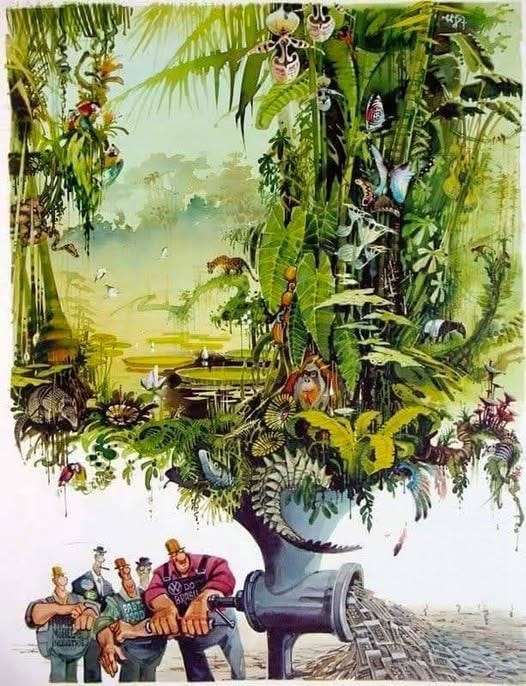
In the age of the Anthropocene, we’ve become acutely aware of our impact on Gaia’s planetary surface and how we have contributed to her scars. Our industries have carved wounds into her forests, our emissions have polluted her skies, and our unconscious consumptive behaviors have strained her delicate balance.
Thanks for reading! Subscribe for free to receive new posts and support my work.
Yet, this awareness is a clarion call… Not to despair, but to reimagine our role. We stand upon this pale blue dot, not as conquerors but as caretakers, as co-creators of the world to come. To do so, we must evolve beyond anthropocentrism, the belief that humanity is the sole arbiter of value, and embrace a universal consciousness that reconnects us with the living systems of Terra, our nurturing home, which must be sustained, protected, and revered.
Thought Leadership in a New Era of Consideration and Care
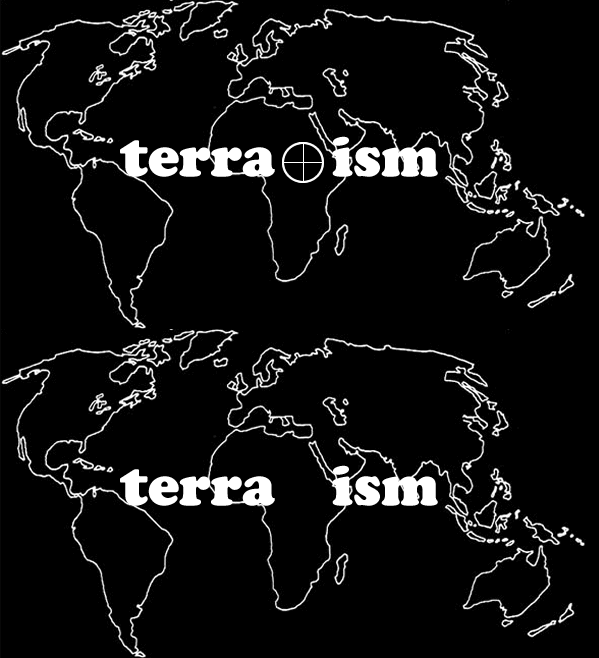
This shift requires a new ethos, one that replaces fear with love, division with unity, and destruction with symbiosis. In 2008, the concept of Terraism emerged as a love-based paradigm to counter the fear-driven narrative of terrorism. I had the vision to restore a proper perspective of a philosophy rooted in love for Terra to supplant the war on terrorism, as terrorism is war itself, which is a contradiction in terms and a complete oxymoron. Unlike terrorism, which thrives on chaos and separation, Terraism invites us to foster a global culture of care, rooted in reverence for our planet and all its inhabitants. It envisions a world where governance is guided by benevolence, where resources are shared equitably, and where humanity’s ingenuity serves life rather than exploits or desecrates it. Terraism is not a utopian dream but a practical framework for aligning our behaviors with the rhythms of Gaia, ensuring her flourishing for generations to come.
Reenvisioning the Sacred
This vision finds resonance in the work of thought leaders through time, and the torch has been carried by new generations of philosophers who align with this worldview. Paul Harrison, author of “Elements of Pantheism” and founder of World Pantheism’s perspective, is more scientifically leaning, and Universal Pantheism is for the more spiritually focused. Other fellow pantheists like Perry Rod’s Pantheism group and website Pantheism Community, seek to create dialogue, educate others, and inspire humanity toward a conscious awareness of the beauty of the cosmos and our interconnected nature of being.
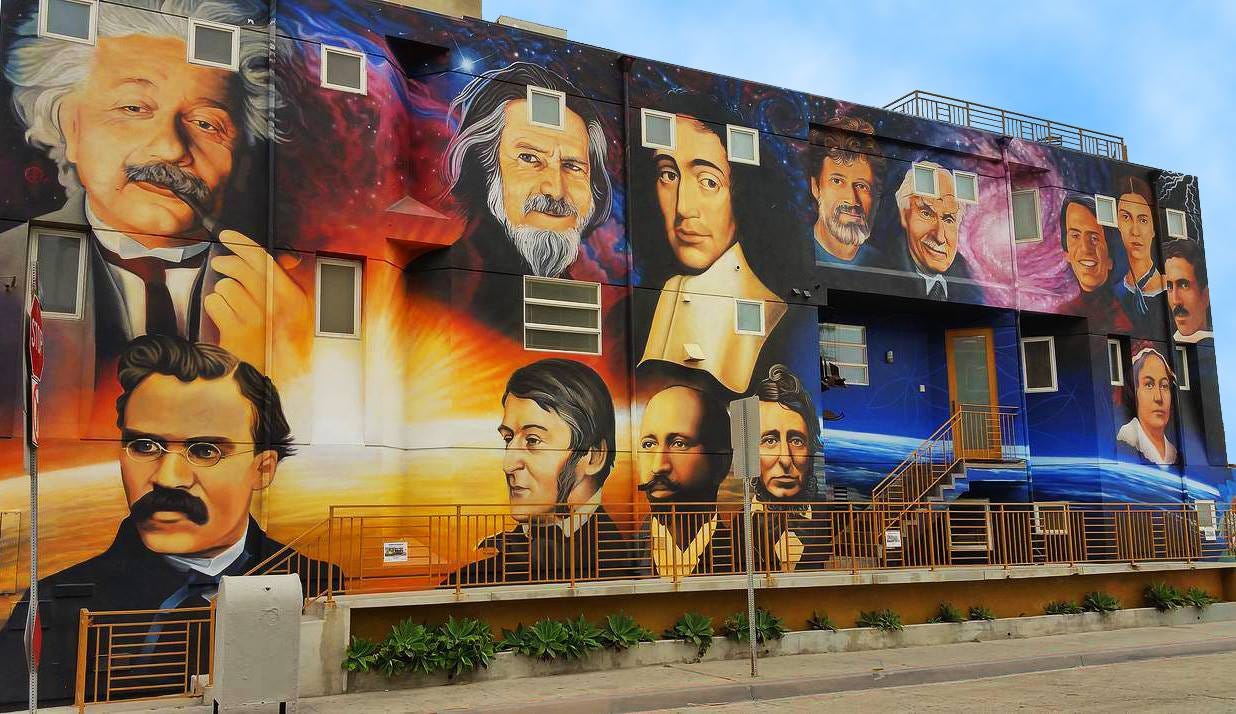
“2201 Ocean Front Walk, Venice CA 90291 In 2015, notable Los Angeles muralist Levi Ponce was commissioned to paint "Luminaries of Pantheism" for an area in Venice, California that receives over a million onlookers per year. The organization that commissioned the work is "dedicated to celebrating and spreading awareness about pantheism." The mural painting depicts Albert Einstein, Alan Watts, Baruch Spinoza, Terence McKenna, Carl Jung, Carl Sagan, Emily Dickinson, Nikola Tesla, Friedrich Nietzsche, Ralph Waldo Emerson, W.E.B. Du Bois, Henry David Thoreau, Elizabeth Cady Stanton, Rumi, Adi Shankara, and Lao Tzu”
New frameworks of thought have evolved from Pantheism, such as Peter Moriarty (aka Simhadev Ek-Balam), whose philosophy of Biosophy (Facebook Groups Biosophy which got hacked and taken over by people in Southeast Asia, so they had to start over with Biosophy 2.0 ) offers a nature-centric alternative to dogmatic religion and the materialist scientific and economic systems that exploit and commodify life.
Biosophy, meaning “wisdom of life,” has a number of adherents, and is articulated further in Facebook groups by Moriarty and expanded by figures like Poffo Ortiz with Biopantheism, who posits that divinity is not a distant deity but an immanent, emergent force within all living systems. Biotheism, Biopantheism, and other offshoots of nature-based reverence codify pantheist values with a deep ecology perspective, emphasizing ethical living, environmental stewardship, and a profound love for nature. It rejects anthropocentric hierarchies, recognizing that every organism, from the smallest microbe to the mightiest tree, is a thread in the sacred web of life worthy of our reverence and love.
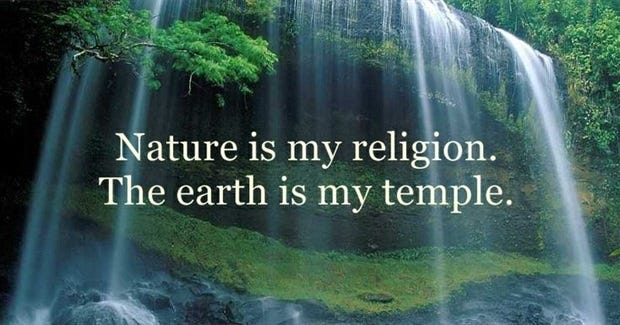
My exploration of Pantheist Spirituality seeks to unify the perennial wisdom of the world’s religions, not as a monotheistic or deistic doctrine, but as a syncretic celebration of our shared reverence for the cosmos, bridging science, soul wisdom, and spirituality. From the animism of indigenous traditions to the nondualism of Advaita Vedanta, from the mysticism of Sufism to the ecological ethics of Deep Ecology, pantheism reveals a common thread: the divine is not separate from us but manifest in the forests, rivers, and stars. By embracing this syncretism, we can transcend the divisiveness of dogma and foster a spirituality that honors Terra as our sacred home.
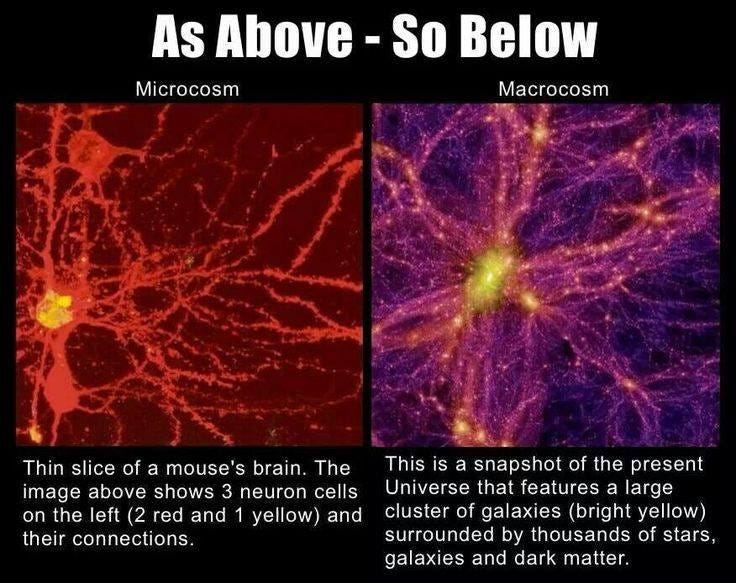
This philosophy aligns with the One Zoom: All Life Project, a digital tapestry that visualizes the interconnectedness of all species, reminding us that our survival is entwined with the health of Gaia’s ecosystems, and how our web of life is interconnected and interdependent.
To live harmoniously is to seek homeostasis - a dynamic balance where humanity supports the web of life rather than unravels it. The Web of Life, by Fritjov Kapra further explains this interconnectedness, that binds us to all beings.
Imagine a world where governance reflects this web, where policies nurture ecosystems, and where education instills reverence for Gaia. Such a world is within our grasp if we change our behaviors, reject fear-based paradigms, and embrace the love-based ethos of Terraism.
A Cosmic Perspective for Collective Survival
Carl Sagan’s reflection on the Pale Blue Dot—that fragile speck in the cosmic void—underscores this unity. “That’s home. That’s us,” he wrote, reminding us that every joy, every sorrow, every triumph, and every failure unfolds on this singular planet.
The Big Picture Effect, or Overview Effect, experienced by astronauts like Edgar Mitchell, amplifies this truth. From space, borders vanish, and the Earth appears as a living, breathing whole. This perspective dissolves the illusion of separateness, igniting a “global consciousness” that compels us to act as stewards, not exploiters. If we could all internalize this view, we might shift our consumptive habits, choosing regenerative agriculture, renewable energy, and circular economies over extractive practices.
The globalist agendas of control, often tinged with eugenicist undertones, lack the imagination to envision a thriving world for all. Their solutions are rooted in scarcity and fear, but Terraism and Biosophy offer a different path: one of abundance, cooperation, and love. Humanity is not a destructive force by nature; we are capable of symbiosis. Indigenous cultures have long modeled this, treating the Earth as a living relative. (See: Indigenous perspectives on the biodigital convergence https://journals.sagepub.com/doi/10.1177/11771801221090748)
By blending their wisdom with modern innovation, we can forge a society that prioritizes life’s sanctity over profit’s pursuit.
The story of human “progress” — the rise of civilizations, politics, money, economics, technology— is a story of separation, division, ignorance and compartmentalization. Not recognizing the immeasurable value and sacredness of Nature is the root cause of many problems humanity is facing now.
Thinking money and material things are more "valuable" than LIFE has blinded us. Understanding how we are deeply connected to Mother Earth (and each other) is our only way home, our path back to wholeness and sanity.
In the story of Adam and Eve, humans lived in paradise, one with God and Nature, until they ate from the tree of "knowledge." Knowledge of good and evil, thinking humans are separate from Nature, that spiritual "reality" is something separate from our everyday existence.
Indigenous cultures don’t compartmentalize the Universe this way, they understand how the spiritual and physical are connected, how humans are a part of Nature. This is the deeper "truth" represented in the Garden of Eden mythology.
Seeing themselves as separate from other people and animals led to beliefs of superiority. This is the beginning of civilization's rise, to the dominance of patriarchy, nationalism, wealth, privilege, violence, technology and militarism.
So here we are now, where economics has become the new global religion. Where we are trained and brainwashed to serve the new gods of money. Where Nature (our Mother) is seen as a resource to plunder, enslave, destroy and turn into dollars. Where billionaires are the new high priests, held up as role models, voices of wisdom we are taught to look up to and worship. Where corporations are given more power than people. Where insanity is presented as normal, with everything and everyone raised from childhood to serve the economic machine.
Most of the problems we struggle with are rooted in an economically obsessed culture of wealth and privilege that perpetuates compartmentalization and psychotic disconnection. We have lost touch with each other, with Nature, with the indigenous wisdom of our ancestors, a deep spiritual awareness of the unity, beauty and interconnection of everything.
The indigenous understanding of the sacredness of life and nature that Eden represented has been suppressed and denigrated. Paradise was never lost, it has just been ignored, enslaved, bought and sold for economic profit.
Thinking value and meaning can be measured in money is the GREAT LIE, the serpent in the garden of our minds. We have become blind to what really matters, to the immeasurable worth and sacred value of everything.
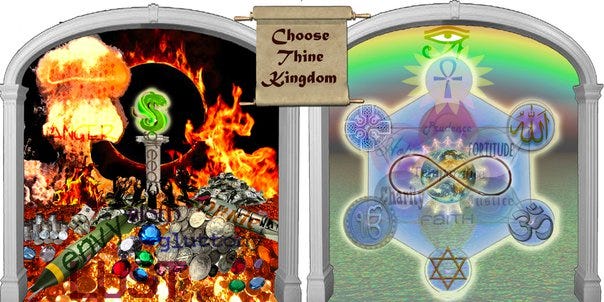
We are at a pivotal moment in the age of the Anthropocene. Will we continue to scar Terra, or will we weave a new story of reverence and renewal? '
The choice is ours.
Let us stand as caretakers, guided by a universal consciousness that unites us in diversity. Let us honor Gaia with every action, from the food we eat to the policies we support.
Let us reimagine our place on this pale blue dot, not as dominators, but as loving stewards of our only home.
To deepen your connection with Gaia and support the shift toward a nature-centric worldview, explore these lesser-known organizations and initiatives that embody pantheism, deep ecology, intentional living, and land stewardship:
Biopantheism Community – Founded by Poffo Ortiz, this group codifies pantheist values with a deep ecology focus on living systems.


And So It Is!