

“The cause of freedom is not the cause of a race or a sect, a party or a class—it is the cause of humankind, the very birthright of humanity.”
—Anna Julia Cooper, A Voice from the South (1892)
Liberty is the soul of human existence, a sacred right woven into the fabric of reason and justice, demanding that laws uplift rather than oppress. It is not a privilege bestowed by governments but an inalienable truth, rooted in the rational dignity of every individual. Yet, when people that comprise nations enact laws or wield power that trample these natural rights (through legalized oppression, surveillance, or weapons that defy humanitarian principles), society courts a descent into moral decay and disorder.
What is the purpose of law if it serves corruption rather than the common good? Enlightenment thinkers and revolutionary voices of past centuries teach us that justice requires vigilant defense against tyranny. Let us explore the philosophy of liberty, the peril of laws that betray freedom, and the societal entropy that follows their abuse, so that we may reaffirm these truths to counter threats to justice.
suggested playback speed for video: 1.5-1.75
The Philosophy of Liberty: The Foundation of Enlightenment
“The ‘Philosophy of Liberty’ video vividly frames this sacred ideal, portraying liberty as self-ownership and condemning force as murder, slavery, or theft. The philosophy of liberty, born in the Enlightenment, rejects the notion that freedom is a gift from rulers. It is a natural right, derived from the rational capacity of individuals to govern themselves. John Locke’s Two Treatises of Government (1689)1 articulates the social contract: governments protect life, liberty, and property, deriving legitimacy from consent. When laws violate these principles, they betray this covenant and forfeit all legitimacy. The Enlightenment shifted power from monarchs claiming “divine right” to individuals, asserting that justice must align with reason, not on the whim of tyrants. This principle demands that laws uphold natural rights; freedom of thought, expression, and self-determination, lest they sow discord. Today, as surveillance, censorship, and mandates, are being legislated by those bowing to corporate greed, imperil our lives and our liberty, a new generation of “mindless automatons”, seeks to to erode these sacred foundations. Locke’s call to resist unjust laws burns brightly and remains a vital beacon demanding eternal vigilance.
The American Founders: Liberty as a Revolutionary Imperative
America’s Founding Fathers translated Enlightenment ideals into a revolutionary mandate, crafting a vision of liberty grounded in natural law and self-ownership. Thomas Jefferson, in the Declaration of Independence (1776)2, proclaimed that “the God who gave us life, gave us liberty at the same time,” asserting that rights to life, liberty, and the pursuit of happiness are self-evident and inalienable. Yet, the United States’ sanction of slavery until 1865, a profound betrayal of its ideals, fractured the nation. Slaveholders’ defiance of life and liberty ignited a bloody Civil War, claiming President Lincoln’s life, yet his sacrifice blazed as a beacon, affirming America’s quest to be the ‘land of the free’ and enshrining him among its greatest presidents.
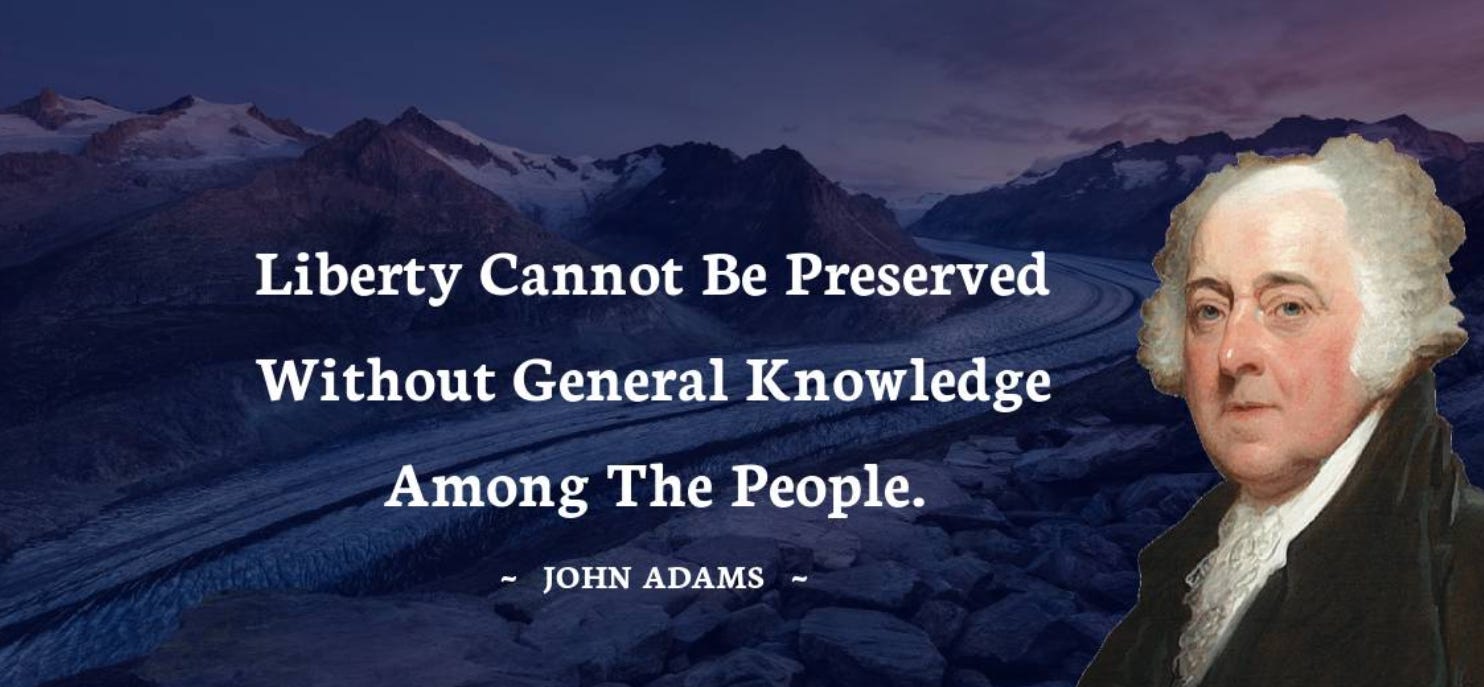
Yet, for a country to remain free, the populace must know what liberty is in order to properly protect and defend it. John Adams, advocating a government of laws, not men, in the Massachusetts Constitution (1780)3, warned that “liberty cannot be preserved without a general knowledge among the people.” Yet today, countless leaders swear on the Bible to uphold the Constitution, only to betray it by endorsing the PREP Act, depriving Americans of their due process, or the Patriot Act, violating privacy. They shield transnational corporations from accountability for harmful pharmaceuticals, and applaud war crimes, extorting taxpayers to fund weapons that rob innocent lives abroad.
Liberty Requires Bravery & Activism in Every Generation
Thomas Paine’s Common Sense (1776)4 and Rights of Man (1791)5 proclaimed liberty’s universal call, declaring, ‘The strength and power of despotism consists wholly in the fear of resistance.’ His Age of Reason (1794)6 condemned institutional oppression, equating religious dogma to political tyranny. Yet, the Alien and Sedition Acts of 1798, aimed at national security, criminalized dissent, defying Paine’s wisdom and curbing free speech. Jefferson and Madison’s fierce opposition, through the Kentucky and Virginia Resolutions, fueled grassroots activism, cementing a cultural commitment to free expression and propelling Jefferson to the presidency in 1800.
Our American founding fathers knew that laws violating our most sacred and natural-born rights, whether through slavery or censorship, undermine legitimacy, inviting resistance and decay. That is why they stood up so rightly to defend them in their age. Yet in our present age, recent censorship, like the Biden administration’s pressure on Twitter and Facebook to suppress speech during the COVID-19 pandemic being challenged in Murthy v. Missouri (2024), only to be dismissed by the Supreme Court. Judicial decisions that give carte blanche to governments and industries to usurp our Bill of Rights mirror these historic betrayals.
Each generation confronts a relentless assault on our Bill of Rights, freedoms forged against England’s monarchy in the Revolutionary War, defended through struggles for free speech, and reaffirmed in the fight to end slavery. Today, irrational leaders wield ‘misinformation’ and ‘disinformation’ as catchphrases to justify censorship, while complicit pundits, forsaking the press’s duty to hold power accountable, serve as mouthpieces for propaganda, stoking fear and division to manufacture consent to increased totalitarian aims of a new generation of dogmatic tyrants and zealots.
Spinoza’s Ethics: Liberty as Rational Freedom
Over a century before the Founding Father’s published their philosophy on liberty, philosopher Baruch Spinoza, in his Ethics (1677)7, defined true freedom as living according to reason, not passion. “The more a man is guided by reason, the more he is free,” he wrote (Part IV, Proposition 68). For Spinoza, the state’s role is to enable rational self-governance, not to impose coercive control. Laws driven by fear or power (such as modern mass surveillance programs like PRISM, exposed in 2013) are irrational and illegitimate, violating the natural right to privacy. By monitoring citizens without transparent justification, such actions erode trust and autonomy, echoing Spinoza’s warning that irrational governance breeds servitude. His social contract, outlined in Theological-Political Treatise (1670), holds that a state’s legitimacy hinges on maximizing individual freedom while ensuring collective order. When governments prioritize control over reason, as seen in today’s global censorship and propagandist media, they betray this covenant, fostering a culture of fear that erodes liberty’s rational foundations.
Kant’s Moral Philosophy: Autonomy and the Moral Law
A century after Spinoza, Immanuel Kant’s philosophy anchored liberty in autonomy, the capacity to govern oneself by rational moral laws. In Groundwork for the Metaphysics of Morals (1785)8, he articulated the categorical imperative:
“Act in such a way that you treat humanity… always as an end and never as a means only” (4:429).
Laws or actions that violate natural rights, such as censorship laws stifling free expression, fail this test by treating individuals as tools of state power. In Critique of Pure Reason (1781)9, Kant emphasized reason as the foundation of autonomy, enabling just laws that respect human dignity. Modern examples, like proposed U.S. speech regulations, defy this principle, suppressing the rational exchange of ideas. Kant’s framework deems such laws morally invalid, as they cannot be universalized without contradicting justice. When states prioritize control over autonomy, they invite moral decay, undermining the rational order that liberty demands.
Violations of Freedom: Past & Present
History and modernity abound with laws and actions that defy natural rights. In the U.S., slavery’s legal sanction until 1865 violated the right to liberty, exposing a moral hypocrisy that fractured the nation. The Alien and Sedition Acts of 1798 curbed free speech, betraying our Founding Fathers’ vision. Today, the PRISM program invades privacy without consent, treating citizens as suspects without due cause. Censorship, like the Biden administration’s targeting of online speech in Murthy v. Missouri (2024), stifles expression, defying our forebears’ vision of universal liberty. Each violation hastens the decay of justice, feeding entropic systems. Our creative will must rise to reclaim liberty’s promise.
“Eternal vigilance is the price of liberty.”
The Consequences of Inaction: Moral and Societal Entropy
Unchallenged violations of natural rights erode justice and lead to moral entropy. “Eternal vigilance is the price of liberty,” Wendell Phillips warned in 1852, a truth echoed by history. The fall of Rome, where unchecked corruption eroded civic virtue, serves as a cautionary tale. Today, normalizing surveillance or censorship creates a culture of fear and apathy, where citizens accept eroded freedoms as inevitable. Without accountability (through legal challenges, public advocacy, or international pressure), violations multiply, and moral decay sets in. Paine’s call to resist despotism, Spinoza’s demand for rational governance, and Kant’s insistence on autonomy all emphasize the need for our vigilance to ensure accountability. A society that fails to uphold natural rights risks becoming a hollow shell, where powers supplant principles and virtues are buried under our vices.
Reaffirming Liberty: The Path Forward
The wisdom of Jefferson, Adams, Paine, Spinoza, and Kant offers a roadmap to reclaim liberty, a torch borne by modern heroes who inspire us to be torchbearers too. Their principles, rooted in sacred rights, rational governance, and autonomy, demand we continue to challenge unjust laws.
In Idaho, Leslie Manookian, president of Health Freedom Defense Fund, co-authored the Idaho Medical Freedom Act (2025)10, banning mandates for vaccines or medical interventions, ensuring no Idahoan faces coercion in employment or education. By standing up to the pharmaceutical complex, from lawsuits ending mask mandates, to exposing Big Pharma’s influence, echoes Paine’s resistance to tyranny.
Edward Snowden, exposing NSA’s mass surveillance in 2013, revealed violations of privacy11, while Daniel Ellsberg’s 1971 Pentagon Papers publication exposed Vietnam War deceptions12, hastening its end. Both, alongside other whistleblowers challenging the military-industrial complex’s war profiteering, uphold Jefferson’s vision.
Legal challenges, like those by the ACLU against surveillance, uphold privacy and due process, or by attorneys like Jeff Childers against the PREP Act’s unconstitutional legislative overreach13, or by Tom Renz’s support for whistleblowers exposing DoD injury record manipulation14, or by Aaron Siri, standing up to captured government agencies, challenging their unsubstantiated claims and secrecy to serve corporate interests at the expense of people15.
Grassroots movements, from free speech to civil rights, reaffirm the public’s role in defending liberty. Internationally, upholding the ICCPR, ratified by the United States in 199216, honors humanitarian principles. Every violation of sacred rights demands a fervent response, a clarion call to reaffirm justice to counter social disorders.
As Edmund Burke warned, “The only thing necessary for the triumph of evil is for good men to do nothing.” Liberty is a living principle, requiring vigilance to prevent moral decay and ensure that law serves to uphold the soul of justice, not tyrants who seek to deprive us of our lives or our liberty.

“Freedom is not the absence of restraints, but the courage to resist them.”
—Mary Wollstonecraft, A Vindication of the Rights of Men (1790)
Like my Content? Support my work with ko-fi
John Locke, Two Treatises of Government (London: Awnsham Churchill, 1689), https://www.gutenberg.org/ebooks/7370
Thomas Jefferson, “Declaration of Independence,” July 4, 1776, https://www.archives.gov/founding-docs/declaration
Massachusetts General Court, “Constitution of the Commonwealth of Massachusetts,” https://malegislature.gov/Laws/Constitution
Thomas Paine, Common Sense (Philadelphia: R. Bell, 1776), https://www.gutenberg.org/ebooks/147
Thomas Paine, Rights of Man (London: J.S. Jordan, 1791), https://www.gutenberg.org/ebooks/3742
Thomas Paine, Age of Reason (Paris: Barrois, 1794), https://www.gutenberg.org/ebooks/3743
Baruch Spinoza, Ethics (Amsterdam: 1677), https://www.gutenberg.org/ebooks/3800
Immanuel Kant, Groundwork for the Metaphysics of Morals (Königsberg: 1785), https://www.gutenberg.org/ebooks/5682
Immanuel Kant, Critique of Pure Reason (Riga: Johann Friedrich Hartknoch, 1781), https://www.gutenberg.org/ebooks/6342
Health Freedom Defense Fund: Idaho Leads the Nation with Landmark Medical Freedom Legislation: https://healthfreedomdefense.org/idaho-leads-the-nation-with-landmark-medical-freedom-legislation/
BBC, “NSA surveillance exposed by Snowden ruled unlawful” 3 September 2020 https://www.bbc.com/news/technology-54013527
“Remembering Daniel Ellsberg, Who Leaked the Pentagon Papers,” NPR, June 23, 2023, https://www.npr.org/2023/06/23/1184133467/remembering-daniel-ellsberg-who-leaked-the-pentagon-papers
Moms For America et al v. U.S. Dept. of Health and Human Services et al, Florida Middle District Court, Case No. 3:24-cv-00650, filed June 25, 2024 https://www.pacermonitor.com/public/case/54049560/Moms_For_America_et_al_v_US_Dept_of_Health_and_Human_Services_et_al
Leaked U.S. Department of Defense DMED (Defense Medical Epidemiology Database) January 24, 2022, https://zenodo.org/records/5985602
New York Post, FDA must disclose more COVID-19 vaccine records, US judge rules https://nypost.com/2024/12/06/business/fda-must-disclose-more-covid-19-vaccine-records-us-judge-rules/
United Nations, “International Covenant on Civil and Political Rights,” ratified by U.S. 1992, https://www.ohchr.org/en/instruments-mechanisms/instruments/international-covenant-civil-and-political-rights.
Good, informative article, thank you.
Islam is an increasing threat to Western nations, particularly in the UK and Europe. It gains positions of influence, and is well on the way to winning demographically.
It has to be halted, or else Western civilisation will perish.
I have a feeling that Spinoza will play a significant role in dismantling Islam.
See my article:
"Could Spinoza help to destroy Islam?
And would there be unintended consequences?"
https://hellish2050.substack.com/p/could-spinoza-help-to-destroy-islam
Please subscribe. My articles are free.