

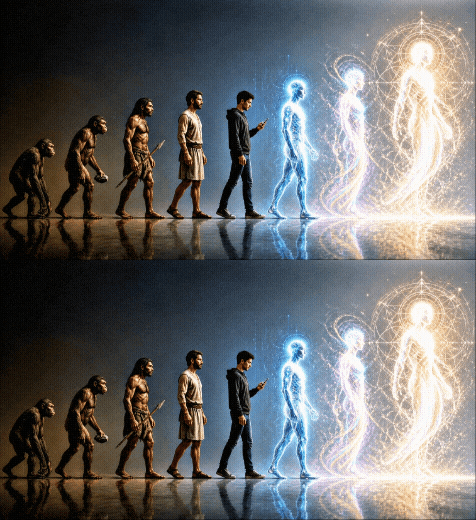
A quiet revolution has already taken place inside the human body, and almost no one was asked to vote on it.
The architects of this revolution do not wear crowns or carry swords. They sit on standards committees, publish white papers at Davos, and fund laboratories where biologists speak fluent code. They call themselves technocrats when they are arranging the operating system of society, and transhumanists when they are arranging the operating system of the human being. The two roles have merged into one unelected authority over the conditions of human existence. Their shared dream is a world in which every heartbeat, every thought, every flicker of desire can be measured, predicted, and, when convenient, rewritten.
Most people first met this future through the language of medicine: a smartwatch that counts steps, an mRNA injection that teaches cells to make a protein, a biosensor no larger than a dust mite slipped into the bloodstream to monitor what the body whispers to itself. Each step seemed small, humane, even noble. Yet each step also laid another wire in a vast, invisible net now tightening around the living world.
The net has a name in the engineering literature: the Internet of Bio-Nano Things (IoBNT). Its backbone is the coming 6G standard, a frequency realm so high that it can pass through skin and bone as easily as Wi-Fi passes through drywall. Terahertz waves, the quiet carriers of 6G, are short enough to vibrate individual water molecules and delicate enough to be scattered by the breath you just exhaled. Engineers love them because they can carry a terabit of data per second. They also love them because those same waves can link billions of tiny devices floating inside the bloodstream or embedded in living tissue.
In the summer of 2025, a paper appeared in Computers in Biology and Medicine describing how 6G terahertz channels will allow physicians, and whoever holds the access credentials, to read the electrical chatter inside a heart valve or a strand of hippocampus in real time.1 Another paper accepted by the 9th Workshop on Molecular Communications, explained how "semantic communication" layers will let the network understand the meaning of that chatter, not just the raw signal.2 A third filing, Microsoft's WO2020060606, granted to Microsoft Technology Licensing, patents a cryptocurrency system that harvests human body activity, explicitly including brain waves and body heat, as the computational proof-of-work for mining digital currency. Tasks are assigned by information and service providers. The body performs them. Cryptocurrency is awarded as the return. The patent notes that "a user can solve the computationally difficult problem unconsciously."3 The body labors. The platform profits. The person need not even know it is happening. These are not predictions for 2040. These are systems being tested today in military laboratories and teaching hospitals, systems that will migrate into consumer life the way GPS and night-vision goggles once did.
The patents tell the rest of the story with a cold clarity no press release can soften. One recently granted filing describes synthetic DNA sequences that, once inside a neuron, respond to terahertz pulses by opening ion channels on command, brightening or dimming a thought the way a dimmer switch adjusts a lamp.4 Another covers entire populations of engineered bacteria designed to swim through the bloodstream, form ad-hoc antennae, and relay data outward through the skin.5 We are now in the age where large language models can literally be trained on the private electrical signature of a single human brain, and then sell the resulting "behavioral nudge" back to advertisers, insurers, or governments.
All of this is justified, always, by the language of safety. There are now laboratories, some funded by our own tax dollars, some hidden in other countries, that can assemble pandemic-grade viruses in weeks. The same tools that can edit an embryo can edit a smallpox genome. Against such threats, the argument runs, we must see inside every body, in real time, everywhere. The danger is real. The response has handed the most intimate keys of life to institutions that have never demonstrated reverence for anything except their own continuance.
That is the heart of the betrayal. The human body is not a machine in need of an operating system update. It is a cathedral built of four billion years of improvisation, a living poem whose verses are written in calcium and water and light. Every breath is a negotiation with invisible forests of microbes. Every dream is a collaboration between flesh and something older than language. To treat this miracle as raw material, as a server farm that happens to walk and laugh and pray, is an act of desecration dressed in the vocabulary of progress.
The men and women driving this forward often describe themselves as atheists. They believe the universe is matter and nothing but matter, and therefore, everything that moves can be moved by them. They have not noticed that matter itself is mysterious. A quark knows nothing of humanly contrived arrogance, it obeys laws written before the first human eye ever opened. A photon travels a hundred thousand years through the arm of a galaxy just to be caught by the rhodopsin in a retina and become, for one fleeting moment, the color blue. There is a memory in the fabric of things, a memory that registers every violation.
One day, every engineer who filed a patent to rewrite another person’s will, every bureaucrat who classified a child’s heartbeat as “telemetry,” every investor who funded the desecration for stock options, will stand before that memory. No firewall will protect them. No nondisclosure agreement will travel with them. The substratum they dismissed as superstition will ask a single question they never modeled: What did you do to the least of these, My living ones?
Until that day, we have a choice. We can refuse the injection that contains more than medicine. We can decline the implant that promises convenience. We can turn off the devices that harvest our attention and our pulse. We can speak aloud the names of the standards committees and the patent numbers and the billionaires who believe they purchased the right to rewrite creation. We can remember that the body is already sacred, already miraculous, already far wiser than the coldest machine ever sold as salvation.
The wires are being laid. The frequencies are rising. But the song inside the blood is older than silicon, older than electricity, older than fear. And that song has not yet given anyone permission to change its lyrics.
Further Reading
The Internet of Bodies and Beyond

We mustn’t be caught by surprise by our own advancing technology.”
Singh et al. “The revolutionary impact of 6G technology on empowering health and building a smart society: A scoping review.” Computers in Biology and Medicine, Vol. 194, 2025. https://www.sciencedirect.com/science/article/abs/pii/S0010482525008479
Cai, Hanlin and Akan, Ozgur B. “Semantic Learning for Molecular Communication in Internet of Bio-Nano Things.” Accepted, 9th Workshop on Molecular Communications, April 2025. https://arxiv.org/abs/2502.08426
Microsoft Technology Licensing, LLC. Cryptocurrency System Using Body Activity Data. WIPO Patent WO2020060606A1, filed June 19, 2019, published March 26, 2020. https://patents.google.com/patent/WO2020060606A1/en
Chen et al. “A Non-Invasive and DNA-free Approach to Upregulate Mammalian Voltage-Gated Calcium Channels and Neuronal Calcium Signaling via Terahertz Stimulation.” 2024. https://www.ncbi.nlm.nih.gov/pmc/articles/PMC11653603/
Bilir, A., Yavuz, M., Seker, U.O.S., Dumanli, S. “Wireless in-body sensing through genetically engineered bacteria.” Nature Communications, November 2025. https://www.nature.com/articles/s41467-025-65416-5