

You work forty hours. Your rent takes half. Healthcare premiums another quarter. You’re productive, skilled, and valuable. Yet you’re perpetually one emergency away from catastrophe.
What might be misconstrued as personal failure for not having enough savings might be better ascribed to systemic extraction by design.
The symptoms surround us: endless wars fueled by profit, chronic illness profiteered by pharmaceutical empires, food from chemically depleted soil costing more each year while delivering less nutrition, ecological collapse driven by industrial extraction, and widening chasms of inequality where elites (the parasitic class) hoard while the rest scramble. These are predictable outcomes of systems built on extractive parasitism.1 Political and economic powers abuse their positions for selfish gain, perpetuating the antiquated ruler-owner-renter construct that drains agency from individuals and communities alike.2
What follows is a treatise on societal transmutation: practical architecture for the inversion already underway. The symptoms are real. The extraction is by design. And the path out is being built.
The Hidden Axis: Freedom Versus Tyranny
The glamour trap is the left-right spectacle. Media and institutions present politics as a binary choice between two flavors of authoritarianism: one promising state control for “equity,” the other corporate capture for “growth.” Both centralize power, both enable parasitism, and both sideline the real axis: authoritarianism versus libertarianism.3
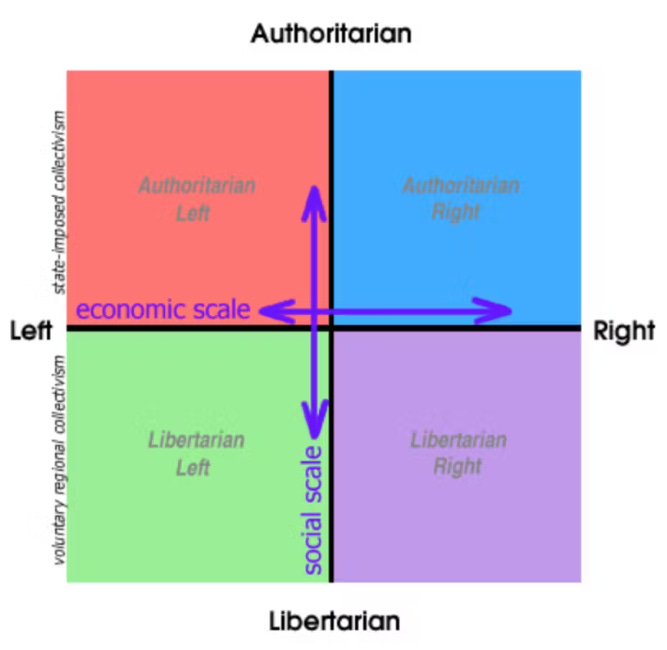
The more important choice must be reframed: not left or right within the upper authoritarian quadrants — where both present-day Democrats and Republicans largely reside — but freedom versus tyranny.4 This distinction matters urgently because sovereignty efforts keep getting mislabeled as "communist" when they represent the opposite end of the spectrum entirely, seated in the lower-left and right quadrants of libertarianism. The left quadrant of libertarianism is the exact polar opposite of upper-right authoritarianism, where most executive office holders ideologically reside.
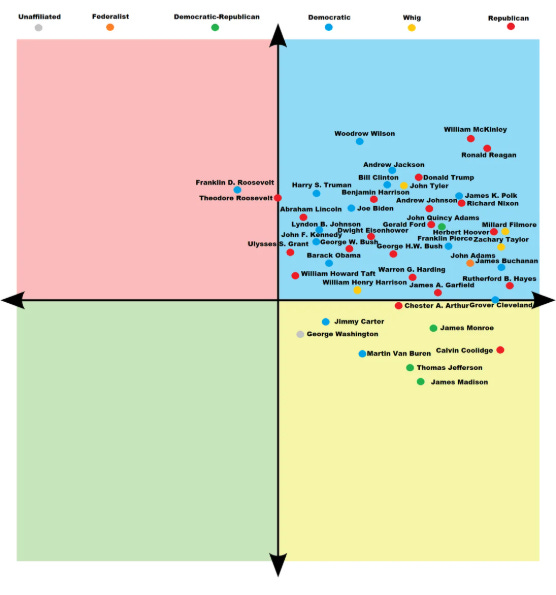
The Political Compass already improves on the left-right binary by adding a second axis — but even two axes flatten the actual complexity of ideological space. Real positions don't sit neatly in quadrants; they occupy multiple dimensions simultaneously, and the most generative philosophies refuse any fixed corner entirely. The interactive tool below makes this viscerally apparent.
Rotate the space and watch how the Anarchist and Syntropic nodes become impossible to place on any flat map — they only become visible when you add the third dimension. This is a structural argument about why the duopolistic choice between two flavors of authoritarianism isn’t just politically limiting — it’s cognitively incomplete.
Understanding Cooperative Libertarianism vs. Authoritarian Collectivism
Cooperatives for food sovereignty (e.g., CSAs, victory gardens, regenerative food forests) exemplify voluntary, decentralized agency.5 Nobody forces you to join a CSA. No state mandates your participation in a community garden. No authority dictates what you grow or how you share it. These are bottom-up divestment strategies from corporate poisons and monopolizing enclosures of the commons (soil, air, water).
Communist collectivism centralizes control through state force: mandated participation, top-down resource allocation, punishment for opting out.
Cooperative libertarianism decentralizes power through voluntary association: consensual participation, bottom-up resource sharing, and freedom to exit.
The difference is the axis of authoritarianism versus liberty, not the economic left-right spectrum. The same principle applies across domains: education, healthcare, housing, economics. The solution requires inversion: transmuting hierarchical parasitism into holarchical symbiosis,6 aligning with natural law’s balance rather than greed, hubris, or unethical dominion.7
As we enter the biodigital convergence era8 (where biology and digital systems merge through AI, nanotechnology, and bioengineering) this inversion becomes even more urgent.9 The timeline is already compressing. AI increasingly mediates decisions once made by human judgment alone. Genetic editing moves from laboratory to commercial availability. The merger of biology and technology advances faster than the governance structures meant to contain it. The structures we build now determine whether these tools serve symbiosis or extraction. The window for conscious intervention narrows with each passing year.
Without conscious inversion, convergence amplifies parasitism. With it, we blueprint futures of reverence for life and proper stewardship for generations yet unborn.
Exposing the Extractive Core
The Political Compass reveals the trap: one axis economic (left-collective to right-market),10 the other social (authoritarian-control to libertarian-freedom).11 Most “choices” land in the authoritarian12 quadrants: state mandates or crony corporatism, while libertarian paths (voluntary cooperation, decentralized agency) remain marginalized.
Extractive parasitism defines the disease: elites behave like societal parasites, consuming resources (e.g., taxpayer funds, natural commons, human labor) without renewal.13 The evidence is not anecdotal; wealth concentration has accelerated across every measurable index for decades.14 Hierarchies enable this by design. Top-down pyramids concentrate power and stifle emergence,15 producing closed systems that are rigid where they need to be adaptive, and brittle precisely where resilience is most demanded.16
In food systems, transnational agribusiness encloses the commons, depleting soil and health for profit. In education, centralized curricula extract student potential for corporate testing empires. In healthcare, patent monopolies parasitize public research. In housing, landlords extract rents without building equity. The result: imbalance, conflict, and collapse.17
Humanity’s trajectory under scarcity, debt-traps, greed, and authoritarian dominion is unsustainable. Greed thrives on war and disease, but reverence for interconnectedness (and for natural law) offers a wiser path.18 Natural law, inherent in human nature and discoverable through reason, asserts universal principles of autonomy, mutual flourishing, and balance.19 Aligning societal structures with it ameliorates symptoms, fostering adaptive, cooperative futures of truly mutual benefit.
The Structural Key: From Hierarchy to Holarchy
Hierarchies dominate because they mimic conquest: unidirectional power flows downward, parts subordinated to the whole, with human agency eroded20 (an organizational model whose dominance is far more recent and contingent than we're led to believe).21 Think corporate pyramids where decisions flow from executives to workers, profits flow upward, and feedback gets ignored. It is a closed system that inevitably leads to entropy.
An alternative construct is an open system in alignment with creation as a wholistic homeostasis. Arthur Koestler coined “holon” (from Greek holos, “whole”) to describe entities that are simultaneously autonomous wholes and integral parts of larger systems.22 Consider: cells function independently yet form organs. Organs operate autonomously yet comprise bodies. Individuals think freely yet participate in communities. Each level is both sovereign and integrated.
The arrangement is holarchy rather than hierarchy (dominator rule): nested holons linked by communication and mutual regulation, where each level enhances the others without domination.23 Think mycelium networks in forests: each fungal thread operates independently while contributing to vast interrelated systems that nourish entire ecosystems simply through symbiotic exchange — the same principle holarchic organizational models apply to human institutions.24
Holarchies are healthier because they emulate natural law’s patterns: ecosystems where species coexist symbiotically, each autonomous yet interdependent.25 Resilience emerges from adaptability: lower holons self-regulate while contributing to the whole; feedback loops prevent parasitism; symbiosis replaces extraction.26 In contrast, rigid hierarchies foster brittleness: cancerous overgrowth at the top, atrophy below.
Societal healing requires this transmutation: invert hierarchies into holarchies. Sovereign cooperatives become the vehicles — voluntary, bottom-up frameworks that restore agency, eschew authoritarian control, and divest from parasitism. These are libertarian tools for mutual flourishing.27
Visualizing the distinction: The three dark-mode holarchy illustrations in this section were generated collaboratively with Grok by xAI to clearly show the distinctions between individual holons, social holons, and artifact holarchies.
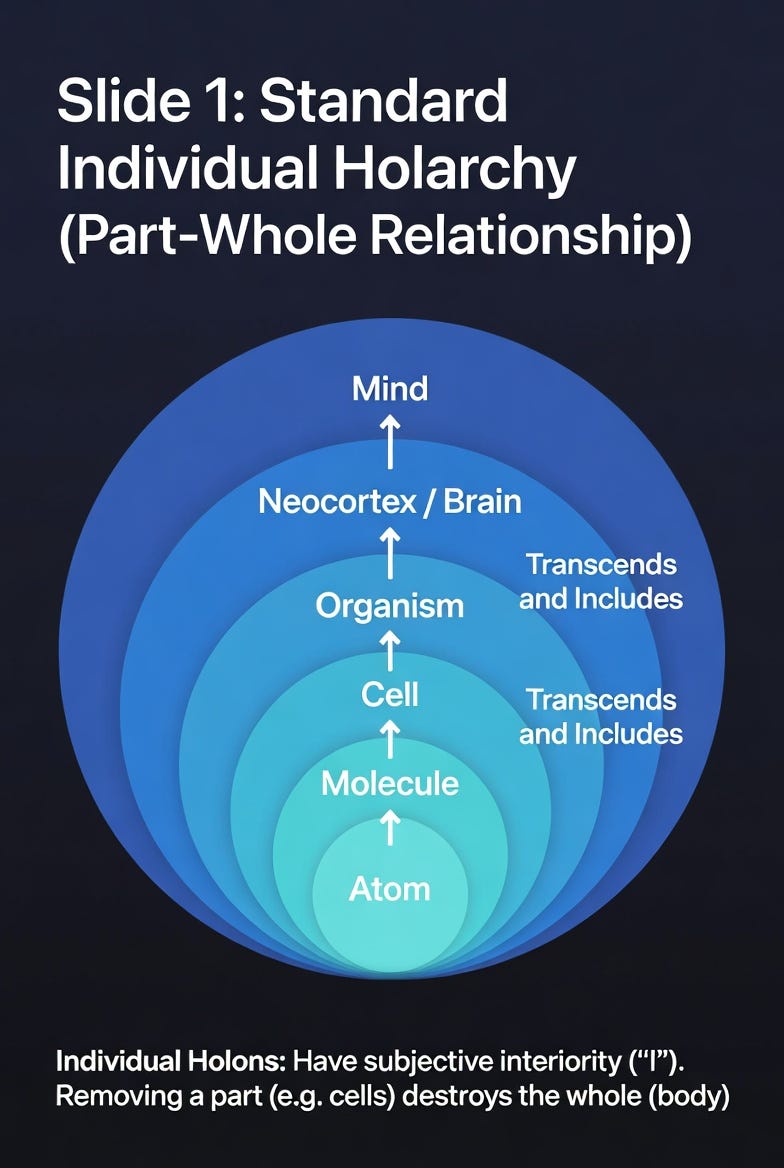
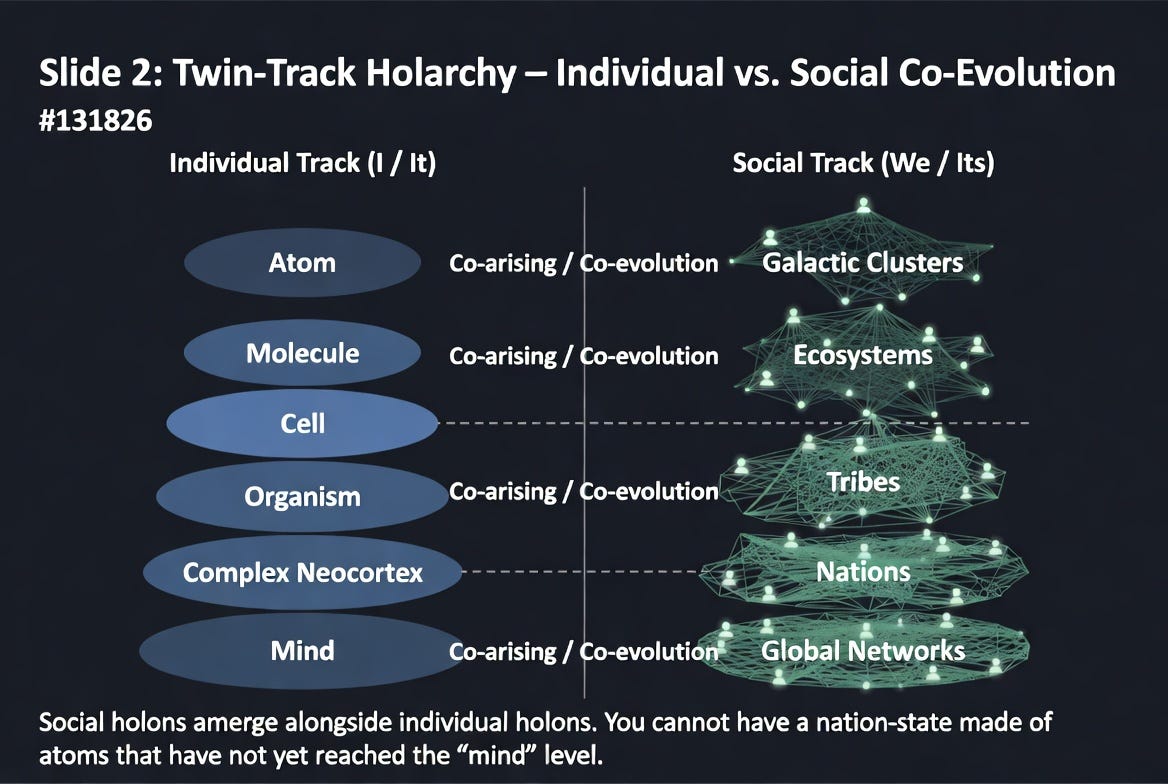
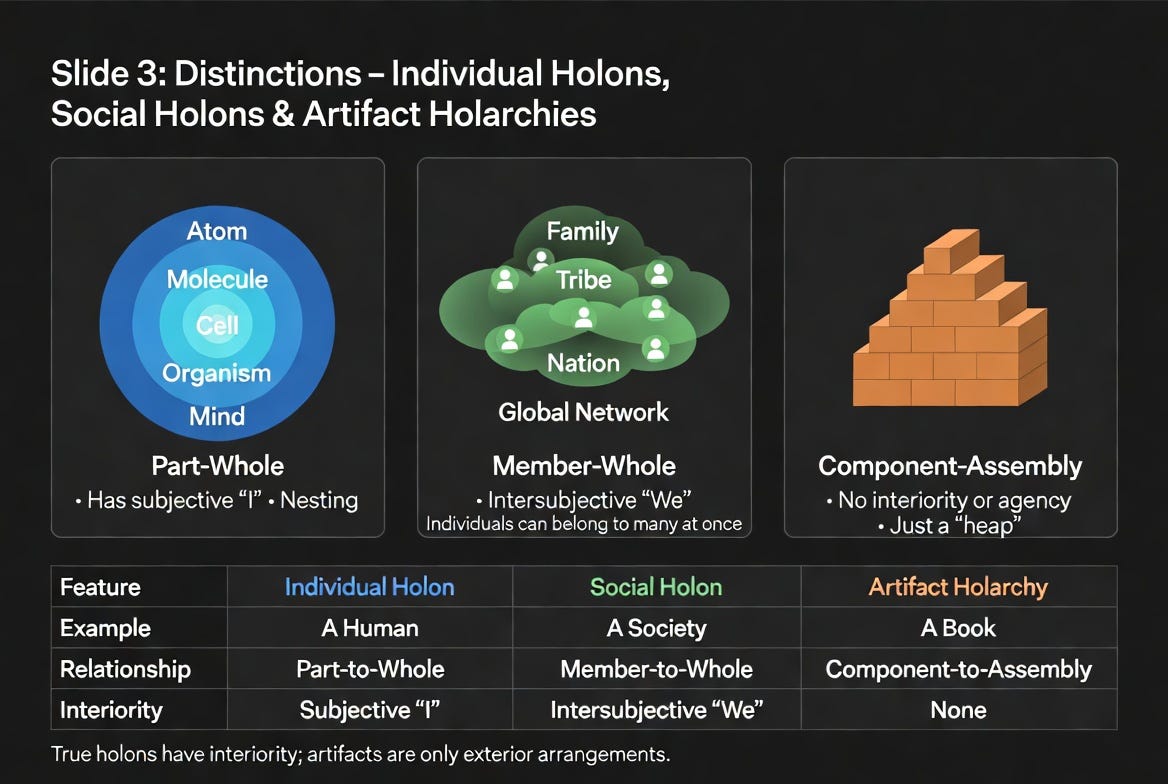
The holarchy diagrams above illustrate nested part-whole relationships — but even a sophisticated four-quadrant framework like Ken Wilber's AQAL (All Quadrants, All Levels) map, the most comprehensive meta-framework currently in wide use, remains a Cartesian grid. It adds developmental altitude to the standard axes, which is a genuine advance. The limitation is that a grid is still a grid: it can only display the dimensions it was built to hold. The interactive tool below places AQAL's own nodes (i.e., disciplines, states of consciousness, developmental stages, contemplative traditions) into a seven-dimensional space and lets you rotate freely. The faint reference plane shows exactly where Wilber's standard map sits. What falls outside it is the point. If the holarchy argument resonates, this is what it looks like applied to the frameworks we use to think about holarchies themselves.
Sovereign Cooperatives: Holarchic Healing Across Domains
Through collaborative explorations (Discourse on Decentralization and Sovereign Cooperative), one has outlined parallel economies that starve centralized beasts while building regenerative alternatives.28 Here’s how holarchical principles apply across life domains:
🌱 Food Sovereignty
Victory gardens and CSAs reclaim the commons from industrial poisons, forming holarchic loops: individual plots nested in community networks, regenerating soil and health symbiotically. Each gardener decides what to grow. Each household manages its plot. Together they share knowledge, seeds, and harvests. Nobody coerces. Everybody benefits.
📚 Education
Decentralized peer-led cooperatives or blockchain-supported networks transmute hierarchical standards into adaptive, holarchic learning: autonomous learners contributing to collective wisdom.29 Students choose their paths. Teachers share expertise freely. Communities validate skills through demonstrated competence rather than standardized tests.
🏥 Healthcare
Multi-stakeholder models (e.g., Italy’s integrated co-ops, patient-governed data trusts like Switzerland’s MIDATA) shift from pharma extraction to symbiotic care: prevention balanced with treatment, agency restored.30 Patients own their health data. Practitioners collaborate across specialties. Communities invest in wellness infrastructure.
🏠 Housing
Community land trusts and limited-equity co-ops (such as Co-op City in New York, or the Northern California Land Trust, for example) invert renter exploitation: residents as autonomous holons in cooperative wholes, building equity without parasitic landlords.31 Families control their homes. Communities steward the land. Future generations inherit stable foundations.
💱 Broader Applications
Sovereign money co-ops for economic homeostasis; decentralized tech ecosystems for agency in innovation.32
These holarchic structures ensure adaptive futures: emulating forests’ symbiosis over monocultures’ fragility, fostering cooperation over war, reverence over dominion.33
Navigating the Biodigital Convergence
The biodigital convergence brings unprecedented power to reshape life itself.34 The ethical stakes of that power are only beginning to be understood.35 Hierarchical control of these technologies risks dystopia: surveillance states wielding genetic editing,36 corporate monopolies patenting human enhancement, weaponized nanotechnology in authoritarian hands.37
Your Body, Their Grid

A quiet revolution has already taken place inside the human body, and almost no one was asked to vote on it.
Holarchic approaches offer alternatives: open-source biotech governed by multi-stakeholder cooperatives, decentralized AI aligned with natural law principles,38 and community stewardship of genetic commons.39 The aikido principle applies: transmute the energy of convergence toward symbiotic ends.40
Aikido’s central insight is that force met with equal opposing force creates destruction for both parties. The master practitioner neither resists nor retreats — instead receiving the attacker’s energy completely, redirecting it through a pivot, and allowing imbalance already present in the aggressor to complete the throw. The attacker defeats themselves; the practitioner merely guides the trajectory.
This is precisely the relationship sovereign holarchies have with extractive systems. The parasitic class requires hosts — compliant consumers, captured regulators, dependent communities. Withdrawal of participation doesn’t require confrontation. It requires only the pivot: redirect your economic energy into cooperative systems, your food dependence into regenerative networks, your financial participation into credit unions and sovereign money cooperatives. The extractive system’s own momentum — its insistence on perpetual growth, its need for endless consumption — becomes the force that topples it. We need not push. We need only step aside and build.
Rather than resisting technological evolution, we can guide it through holarchic frameworks that preserve autonomy while enabling collective flourishing. This requires vigilance, discernment, and commitment to sovereign cooperation over extractive hierarchy.
The Internal Shift: Transmuting Your Own Thinking
The hardest transmutation isn’t institutional. It’s internal. We’ve been conditioned to see life as competition for scarce resources, to measure worth by accumulation, to view others’ success as our loss. Extractive thinking lives in us.
Holarchic thinking requires recognizing that your neighbor’s flourishing enhances your own. This is an observable reality in healthy ecosystems. When soil microbiomes thrive, plants flourish. When plants flourish, pollinators multiply. When pollinators multiply, harvests increase. Every participant benefits from others’ vitality.
Can you feel this truth in your body? Not just understand it intellectually, but sense the relief of releasing zero-sum thinking? That’s the beginning of transmutation.
The Ultimate Inversion: Selflessness as Enlightened Selfishness
Selflessness, or acting for the whole, is the ultimate selfishness.41 Greed’s short-term gains lead to collapse; reverence yields exponential returns in resilient, thriving communities.42
By divesting from parasitism and building holarchic cooperatives, we invert the paradigm: agency multiplies, balance restores, futures brighten. Those profiting at others’ expense will lose their sacred cash cows as symbiosis prevails.
Your Pathway: Graduated Actions for Systemic Change
People stay trapped partly because they don’t see believable pathways forward. Here’s how to begin, scaled to your current capacity:
This Week: Individual Defection
Buy from one farmer’s market vendor instead of a corporate grocery chain
Cancel one subscription service extracting monthly fees for minimal value
Learn one skill (cooking, mending, growing) that reduces dependence
Share one resource (tools, knowledge, space) with a neighbor
This Month: Community Connection
Attend one meeting of a local food co-op, community garden, land trust, or tool library
Connect with one person already building parallel structures in your area
Start one micro-project: balcony garden, skill-share circle, buy-nothing group
Research cooperative models already near you (use the Cooperative Development Foundation directory)
This Year: Infrastructure Building
Join or establish one formal cooperative structure (CSA membership, housing co-op, credit union)
Convert one corner of your space to regenerative growing (even a windowsill counts)
Build one skill to mastery level that you can teach or trade
Organize one monthly gathering for skill-sharing, resource-pooling, or mutual aid
Each small defection starves the beast. Each connection builds the parallel structure. Join or build sovereign cooperatives — via Victory Garden Alliance, Origins Reclaimed, or local land trusts — divest from extractive chains, and advocate for holarchic alignment.43 Recognize voluntary cooperatives as libertarian freedom tools grounded in consent, not coercion:44 CSAs, PMAs, HSAs, land trusts, and mutual aid networks all represent the libertarian quadrants of the Political Compass, not the authoritarian top.45
Humanity can choose consciously: ameliorate diseased symptoms enslaved by greed and control, by shifting our trajectory toward reverence for life, by aligning with natural law, transmuting parasitism into symbiosis, hierarchy into holarchy, and tyranny into sovereign flourishing.
The Vision: What Emerges When Holarchies Reach Critical Mass
Imagine waking in a world where:
Your housing costs build equity in a community trust rather than enriching distant landlords.
Your food comes from regenerative systems you co-steward rather than industrial monocultures.
Your healthcare emphasizes prevention and integrates traditional wisdom rather than symptom management through patent monopolies.
Your education emerges from demonstrated competence and peer validation rather than standardized compliance.
Your work contributes to ventures you co-own rather than corporations extracting your surplus value.
Your technology respects your autonomy and serves your flourishing rather than surveilling and manipulating you.
Your money circulates in cooperative systems maintaining purchasing power rather than debt-based schemes requiring infinite growth.
Your community makes decisions through councils and consensus rather than top-down mandates.
Your bioregion regenerates rather than depletes. Your children inherit adaptive resilience rather than mounting debt.
Realistic symbiosis is natural law embodied in human systems. It’s already emerging in pockets worldwide. The question: will you help it reach critical mass before extractive systems collapse catastrophically? Those profiting at others' expense will find their leverage dissolving. Parasites require hosts. When enough hosts have built parallel systems that meet their needs without feeding the beast, the parasite's power simply evaporates, starved of the participation that sustained it. That is what inversion means: withdrawal from what diminishes, and the steady building of what sustains.
What holarchic seeds are you planting? It’s time to inspire — and be inspired.
🕊️ 🌱 🌌
References & Further Reading
Algorithmic Parasitism — Sustainability Directory / PRISM Explores how certain AI and algorithmic systems extract value from socio-economic or ecological systems without providing reciprocal benefit, functioning as a form of systemic rent-seeking.
Institutional Parasites — ResearchGate (peer-reviewed research) Academic paper by Jukka Rintamäki, Simon Parker, and André Spicer (Academy of Management Review, 2024/2025) that defines “institutional parasites” as actors who exploit an established institution in the short term while undermining it over time.
The Political Compass — politicalcompass.org The official Political Compass website, which presents a two-axis model (economic left-right and authoritarian-libertarian) to map political ideologies beyond the traditional left-right spectrum.
Horseshoe Theory and the false left-right binary — Wikipedia Wikipedia entry on Horseshoe Theory, which posits that the far-left and far-right are closer to each other than to the center.
Victory Garden Alliance — victorygardenalliance.com Organization promoting victory gardens, community-supported agriculture (CSAs), and regenerative food production for greater food sovereignty and resilience.
Arthur Koestler, The Ghost in the Machine (1967) — on holons and hierarchies Koestler’s book that introduces the concept of the “holon” — an entity that is simultaneously a whole and a part — and critiques rigid hierarchies in favor of more organic structures.
Ken Wilber, Integral Theory and holarchy — Wikipedia overview Wikipedia summary of Ken Wilber’s Integral Theory, with emphasis on holarchy (nested levels of reality) and its application across individual, cultural, and systemic domains.
Policy Horizons Canada, Exploring Biodigital Convergence (2020) Canadian government foresight report examining the merging of biological and digital technologies and its potential disruptive impacts on society, economy, and governance.
Integral Theory applied to healthcare and convergence — PMC / NIH Peer-reviewed articles (available via PubMed Central) that apply Ken Wilber’s Integral Theory framework to healthcare systems and emerging biodigital technologies.
Political Compass — methodology and FAQ Official explanation and frequently asked questions from politicalcompass.org about how the Political Compass test works and how to interpret results.
The Political Compass framework — Wikipedia Wikipedia page detailing the structure, origins, and usage of the Political Compass as a multidimensional political mapping tool.
Authoritarianism — Wikipedia Wikipedia entry defining authoritarianism, its characteristics, and historical examples of centralized control over individual freedoms.
World Bank Gini Index — global inequality data The World Bank’s primary measure of income and wealth inequality within and between countries, widely used to track economic disparities.
Our World in Data — Economic Inequality / Gini Index Our World in Data’s comprehensive, visual collection of global statistics and charts on economic inequality using the Gini coefficient and related metrics.
Koestler on hierarchies vs. holons — The Ghost in the Machine Reference to Arthur Koestler’s discussion in The Ghost in the Machine contrasting rigid hierarchies with holonic (part-whole) organizational principles.
Nassim Nicholas Taleb, Antifragile: Things That Gain from Disorder (2012) Taleb’s book exploring systems that benefit from volatility, stress, and disorder rather than merely surviving or breaking under pressure.
Institutional capture across food, pharma, and housing — ResearchGate Peer-reviewed research examining how concentrated interests gain excessive influence over regulatory, economic, and policy decisions in key sectors.
John Locke and the natural law tradition — Stanford Encyclopedia of Philosophy Stanford Encyclopedia of Philosophy entry on John Locke’s contributions to natural law, individual rights, and limited government.
Autopoiesis and homeostasis — Maturana & Varela (Wikipedia) Wikipedia overview of autopoiesis (self-creating systems) and homeostasis as developed by biologists Humberto Maturana and Francisco Varela.
Traditional organizational hierarchy — critique and alternatives (Wikipedia) Wikipedia coverage of hierarchical organizational structures, along with scholarly and practical critiques and proposed alternatives.
David Graeber & David Wengrow, The Dawn of Everything (2021) Book that re-examines human history, challenging conventional narratives about the origins of hierarchy, inequality, and political organization.
Arthur Koestler’s coinage of “holon” — Wikipedia Wikipedia reference to Koestler’s invention of the term “holon” in The Ghost in the Machine.
Integral Life | Official site of Ken Wilber’s work (See articles: “Holons: The building Blocks of the Universe”, “On Holons and Holarchy” by Mayank Chaturvedi, & Piero Mella’s “the Holonic Revolution”.
Holarchical structures applied to organizations — Integral Leadership Review Articles in Integral Leadership Review exploring how holarchic (rather than strictly hierarchical) models can be applied to leadership and organizational design.
Permaculture and ecosystem mimicry principles — Wikipedia Wikipedia entry on permaculture design principles, which emphasize mimicking natural ecosystems for sustainable human systems.
Cybernetics: feedback loops and system stability — Wikipedia Wikipedia overview of cybernetics, focusing on feedback mechanisms that enable self-regulation and stability in complex systems.
Mondragon Corporation — cooperative economic model (official site) Official resources on Mondragon, the world’s largest worker cooperative federation, based in Spain and known for its democratic and participatory model.
Tony Seruga on parallel institutions and legitimacy — X/Substack threads Discussions by Tony Seruga on building parallel institutions, reclaiming legitimacy, and fostering moral courage outside captured systems (primarily shared via X/Twitter threads).
Blockchain and decentralized education networks — Wikipedia Wikipedia coverage of blockchain applications and decentralized technologies in education, credentialing, and learning networks.
MIDATA.coop — patient-governed health data cooperative (Switzerland) Swiss nonprofit cooperative that gives citizens control over their personal health data through a secure, member-owned platform.
Community Land Trust resources — Schumacher Center for a New Economics Resources from the Schumacher Center advocating community land trusts as a model for democratic, affordable, and stewardship-based land ownership.
Sovereign money proposals and cooperative finance frameworks — Wikipedia Wikipedia entries on alternative currencies, sovereign money systems, and cooperative finance models outside traditional banking.
Forest ecology and symbiosis vs. monoculture — Wikipedia Wikipedia discussion of forest ecosystems, symbiotic relationships (e.g., mycorrhizal networks), and the fragility of monoculture systems.
Policy Horizons Canada — Biodigital Convergence report (2020) The original 2020 foresight report by Policy Horizons Canada on the merging of biological and digital systems (full title: Exploring Biodigital Convergence).
Biodigital convergence: ethical implications — PMC / NIH Peer-reviewed articles (via PubMed Central) examining ethical, societal, and governance challenges arising from biodigital technologies.
Shoshana Zuboff, The Age of Surveillance Capitalism — Wikipedia Wikipedia overview of Zuboff’s book analyzing how tech companies extract behavioral data for profit and control.
Eric Drexler, Engines of Creation — nanotechnology risks (Wikipedia) Wikipedia summary of Drexler’s foundational book on molecular nanotechnology, including early discussions of its risks and transformative potential.
Open-source AI ethics and governance — Wikipedia Wikipedia coverage of ethical frameworks, open-source initiatives, and governance approaches for artificial intelligence development.
Decentralized technology and guardrails — Wikipedia Wikipedia entries on decentralized systems (blockchain, peer-to-peer, etc.) and proposed safeguards or governance mechanisms.
Morihei Ueshiba — aikido philosophy of redirecting force (Wikipedia) Wikipedia page on Morihei Ueshiba (founder of Aikido) and the martial art’s core philosophy of harmonizing with and redirecting energy rather than opposing it.
Enlightened self-interest in cooperative economics — Wikipedia Wikipedia discussion of enlightened self-interest and its role in cooperative economic models and mutual benefit systems.
Historical examples of extractive system collapse — Wikipedia Wikipedia references to historical cases where overly extractive or unsustainable systems (economic, ecological, or political) eventually collapsed.
Cooperative vs. collectivist distinctions — historical and modern (Wikipedia) Wikipedia entries contrasting voluntary, bottom-up cooperatives with state-mandated collectivist systems.
Political Compass — analysis and policy application guide Guides and analyses (often from politicalcompass.org or related sources) on interpreting Political Compass results and applying the framework to policy debates.
Integral ecology and holistic systems healing — Wikipedia Wikipedia overview of Integral Ecology (drawing from Wilber’s Integral Theory) and approaches to holistic, systems-based environmental and social healing.
Disclaimer: This piece was developed in collaboration with Claude (Anthropic). Editorial contributions included structural refinement, transition development, and line editing. Beyond Flatland: Interactive 3D Political Compass and Beyond AQAL: Interactive 7-Dimensional Integral Map were developed collaboratively with Claude (Anthropic). The research, concepts, arguments, and vision are the author's own.