

“The few who understand the system will either be so interested in its profits or so dependent on its favours that there will be no opposition from that class, while on the other hand, the great body of the people will bear its burdens without complaint and perhaps without even suspecting that the system is inimical to their interests.”1
— Attributed to the Rothschild Brothers of London, 1863
The first two indictments exposed the mortal wounds to the Bill of Rights and the deliberate destruction of the separation of powers within the United States. This final indictment reveals how domestic treason has metastasized globally, exported through transnational entities that wield debt as a weapon to enslave sovereign nations, commodify fundamental human needs, and transform free citizens into perpetual renters of their own countries.
We once replaced the chains of chattel slavery with the promise of economic freedom. What we constructed instead was a more sophisticated system of bondage, one where the shackles are invisible, forged from compound interest and denominated in fiat currency.
Only when these international monetary chains are shattered, and nations reclaim their sovereign right to exist, will we restore economic justice. Here, we explore international monetary usurpation, debt-trap diplomacy, the architecture of global financial control, housing commodification, the threat of Central Bank Digital Currencies (CBDCs), and above all, the pathways to genuine economic liberation: the wholesale construction of a symbiotic, homeostatic paradigm in which human communities and their planetary host exist in mutual flourishing.
I. The IMF and World Bank as Debt-Trap Architects
“Give me control of a nation’s money, and I care not who makes its laws.”
— Attributed to Mayer Amschel Rothschild2
The International Monetary Fund and World Bank, established in 1944 at Bretton Woods, were marketed to the world as benevolent institutions designed to stabilize currencies and rebuild war-torn economies.3 The reality has proven far darker.
These institutions function as instruments of economic conquest. Their modus operandi follows a predictable pattern: developing nations are enticed with loans for infrastructure projects, roads, dams, and power plants, presented as pathways to prosperity. The loans come with variable interest rates tied to currencies that the borrowing nations do not control.
When commodity prices inevitably fall, currencies devalue, or economic shocks occur, the debt becomes unpayable by design. At this moment of maximum vulnerability, the IMF arrives armed with “structural adjustment programs.”4
The Architecture of Structural Adjustment
These programs demand the systematic dismantling of national economic sovereignty. Privatization of public assets follows first: national utilities, water systems, and telecommunications networks are sold to foreign corporations at fire-sale prices. Deregulation strips protections from local industries, allowing transnational corporations to dominate markets built by generations of domestic labor. Austerity measures deliver savage cuts to education, healthcare, and social services that devastate the most vulnerable populations. Forced border opening allows foreign capital to flood in while local businesses collapse under unequal competition.5
The result is the systematic looting of a nation’s resources, land, and labor by transnational cartels acquiring assets at pennies on the dollar. Under the guise of humanitarian assistance, this system represents conquest by contract: colonialism with a loan agreement in place of gunboats. John Perkins documented this machinery from the inside, describing how nations are deliberately saddled with unpayable debt to force the surrender of sovereignty.6
II. The Trilateral Commission and the Coordinated Capture of Sovereign Policy
“The technetronic era involves the gradual appearance of a more controlled society. Such a society would be dominated by an elite, unrestrained by traditional values.”
— Zbigniew Brzezinski, Between Two Ages: America’s Role in the Technetronic Era (1970)7
The Trilateral Commission, founded in 1973 by David Rockefeller and Zbigniew Brzezinski, represents the institutionalization of global corporate governance masquerading as international cooperation.8
Officially, the Commission exists to “foster cooperation” among the power centers of North America, Europe, and Asia. In practice, it functions as a coordination mechanism ensuring that national governments serve transnational corporate interests above their own citizens. The Commission’s membership reads like a directory of global power: central bankers, multinational CEOs, former heads of state, media moguls, and academic elites. These individuals occupy the revolving door between the Commission and positions of actual governmental authority, advising in one capacity and governing in the next.
Their private policy recommendations systematically become IMF loan conditions imposed on struggling nations, European Union directives that supersede national laws, U.S. trade policies that offshore industries, and international banking regulations that consolidate power. National sovereignty is systematically subordinated to what they euphemistically call “global governance” in energy, finance, health, and trade. The deliberate harmonization of nations into a single corporate fiefdom proceeds until elected governments become administrative branches of unelected corporate boards.9
The Commission’s own founding documents reveal the agenda: managing the “excess of democracy” and creating international structures that transcend national accountability.10
III. The Commodification of Housing and the End of Property Ownership
“Those who labor in the earth are the chosen people of God... Dependence begets subservience and venality, suffocates the germ of virtue, and prepares fit tools for the designs of ambition.”11
— Thomas Jefferson to John Jay, August 23, 1785
The same monetary mechanisms that enslaved nations through sovereign debt now enslave individuals through housing financialization. Central banks, particularly the Federal Reserve, flood markets with artificially cheap credit, deliberately inflating asset bubbles in real estate. Since 2000, median home prices have increased by over 300% while median household incomes have barely doubled. Engineered wealth extraction, operating through the levers of monetary policy, accounts for this divergence.12

Private equity firms, BlackRock, Vanguard, State Street, and their affiliates, deploy billions in Fed-backed cheap money to purchase tens of thousands of single-family homes, converting entire neighborhoods into permanent rental properties. They outbid families, paying cash offers 20 to 50 percent above asking price, making homeownership mathematically impossible for average citizens.13
The strategy is deliberate: acquire the finite supply of housing using infinite fiat currency, then rent it back to the very people who were priced out. Young generations face a future where they will never own property, instead paying perpetual rent to the same financial cartels that own their government.
The Founders understood property ownership as the foundation of independence and citizenship. John Adams wrote that “property must be secured, or liberty cannot exist.”14
Today’s monetary system ensures that such independence remains the exclusive privilege of a new aristocratic class.
IV. Central Bank Digital Currencies: The Final Lock on Economic Freedom
“The issue which has swept down the centuries and which will have to be fought sooner or later is the people versus the banks.”
— Lord Acton15
If housing commodification represents economic imprisonment, Central Bank Digital Currencies (CBDCs) represent the installation of inescapable digital walls.16
CBDCs are programmable, trackable, and controllable tools of absolute financial surveillance and control. Unlike cash, which enables private exchange between free individuals, CBDCs grant central authorities an unprecedented suite of dominion over economic life.17
The Five Pillars of Digital Financial Control
Total surveillance: Every transaction tracked, categorized, and analyzed in real-time. Spending patterns, political donations, purchases, and associations become permanent government records.18
Programmable money: Currency with embedded rules: expiration dates forcing spending, geographic restrictions limiting where one can transact, category prohibitions preventing “unapproved” purchases.
Instant debanking: Dissidents, protesters, or anyone deemed problematic can be financially erased with a keystroke. No due process, no appeal, no alternative. We witnessed this in Canada during the 2022 trucker protests when the government froze bank accounts of protesters and donors without trial.19
Negative interest rates: Savings automatically depleted to force consumption and prevent capital accumulation that might provide independence.
Social credit integration: The ability to participate in commerce becomes tied to compliance scores measuring obedience to state preferences.
CBDCs represent the antithesis of economic freedom. True economic liberty requires decentralized exchange: peer-to-peer transactions that do not require permission from intermediaries. Money must serve as a neutral tool of exchange, a shared medium of value, rather than a weapon of social engineering. The difference between decentralized cryptocurrency and CBDCs mirrors the difference between the printing press and state-controlled media. One liberates. The other enslaves.20
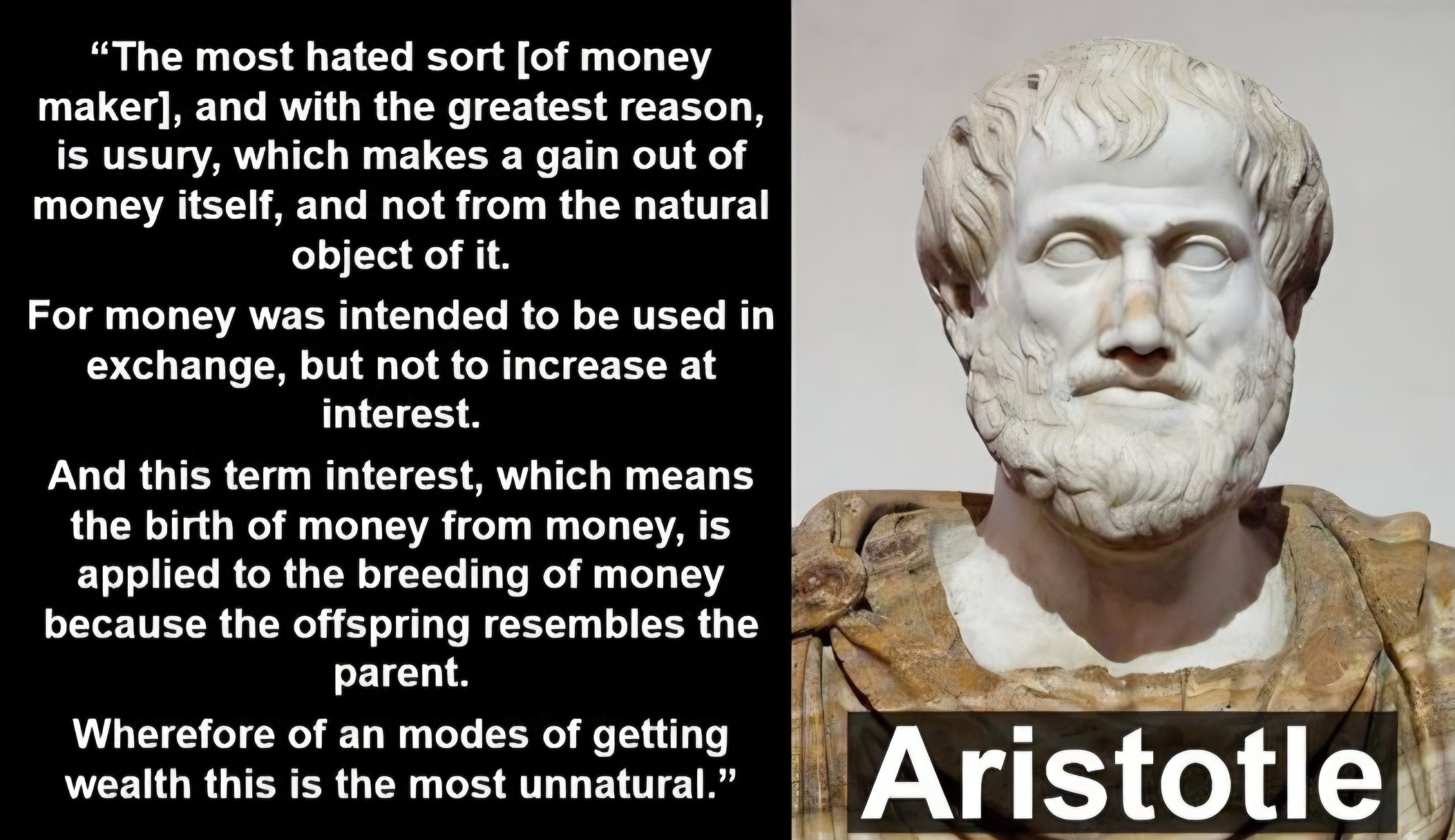
V. The Shift from Free Citizens to Economic Slaves
The combined effect of these transnational mechanisms has achieved what chattel slavery could not: the enslavement of entire populations without the social stigma or moral outcry. Nations lose control of their resources to foreign creditors, their sovereignty subordinated to debt obligations. Individuals lose the ability to own homes, land, or businesses without lifelong servitude to those same creditors. Fundamental needs, shelter, food, energy, and healthcare are systematically financialized, monopolized, and rented back to populations at ever-escalating prices.
We have replaced the explicit chains of chattel slavery with the invisible chains of debt slavery. The plantation has been replaced by the rental economy. The overseer has been replaced by the algorithm. But the fundamental relationship remains unchanged: a permanent underclass laboring to enrich a distant master class they will never meet.

The golden age of justice the Founders envisioned, an era of widespread property ownership, economic independence, and limited government, has been supplanted by a corporate age of perpetual rent and perpetual debt. This represents the final, global usurpation of human liberty. More complete than any previous tyranny, it is presented as freedom itself. It is anything but.
VI. The Path to American and Global Restoration
“When injustice becomes law, resistance becomes duty.”
— Attributed to Thomas Jefferson21
The American republic was founded to create a golden age of justice in which no man, no corporation, and no foreign power stands above the law. That age has not yet arrived, but the tools for its creation already exist in our hands. True restoration requires both defensive actions to break existing chains and offensive measures to build parallel systems of genuine economic freedom.
Sovereign Monetary Independence
National repudiation of odious debt: Under established principles of international law, loans imposed through coercion, corruption, or against the interests of a nation’s people are legally void. Nations must declare IMF and World Bank loans incurred through structural adjustment blackmail to be odious debt requiring no repayment.22
Return to sound money: States and nations must issue currencies backed by tangible assets, gold, silver, or commodity baskets, that cannot be infinitely inflated. Several U.S. states have already begun recognizing gold and silver as legal tender.23
Rejection of CBDCs: Absolute prohibition of Central Bank Digital Currencies at state and national levels, with constitutional protections for the right to transact anonymously using physical currency and decentralized digital assets.
Why this matters: Monetary sovereignty is the foundation of all other sovereignty. A nation that doesn’t control its money supply cannot control its destiny. Sound money protects savings from theft through inflation and prevents governments from funding unlimited expansion through currency debasement.
Withdrawal from Transnational Control
Exit supranational entities: Withdraw from the IMF, World Bank, WTO, and WHO treaties that subordinate national sovereignty to corporate governance. These institutions serve transnational capital, and the national populations they claim to represent bear the cost.24
Restore trade bilateralism: Replace “free trade” agreements written by corporate lawyers with nation-to-nation trade agreements that protect domestic industries, labor rights, and environmental standards.
Why this matters: You cannot serve two masters. Governments must answer to either their citizens or to transnational corporations; there is no middle ground. Every supranational agreement represents a transfer of sovereignty from elected governments to unelected bureaucracies.
Housing and Property Restoration
Ban corporate ownership of single-family homes: Corporations exist to maximize profit, not to house families. Single-family residential properties should be owned by human beings who live in them or by small-scale individual landlords accountable to their communities.25
Punitive taxation on private equity real estate: Impose progressive taxation on corporate ownership of residential properties, starting at 10% annually for the first 100 units and escalating to 50% or above for portfolios exceeding 1,000 homes. Make housing financialization economically untenable.
First-time buyer advantages: Provide significant tax advantages and down payment assistance to first-time homebuyers competing against corporate cash offers.
Why this matters: Property ownership creates stakeholders rather than renters. Homeowners invest in their communities, participate in local governance, and possess economic independence that cannot be revoked by distant landlords. The Founders understood that a republic of renters is a republic already lost.
Decentralized Economic Infrastructure
Private parallel economies: Communities must build economic systems that bypass the debt-money infrastructure entirely:
Community land trusts: Collectively owned land leased to residents, removing properties from speculative markets. Support nonprofit community land trusts that remove housing from speculative markets permanently while keeping homes affordable for working families.26
Local currency and scrip systems: Community-issued currencies accepted by local businesses, keeping wealth circulating locally
Mutual credit networks: Businesses extending credit directly to one another without bank intermediation
Barter and time-banking: Direct exchange of goods and services based on labor hours rather than fiat currency
Decentralized cryptocurrency: Blockchain-based money enabling peer-to-peer transactions without government or corporate surveillance
County-level economic refusal: Local governments must reject corporate monopolies on essential services (water, power, internet) and either operate them as public utilities or support local cooperative ownership.27
Agricultural and energy independence: Support local food systems and distributed energy generation (solar, wind, micro-hydro) to reduce dependence on financialized commodity markets.
Why this matters: You cannot reform a system designed to enslave you. You can only build alternatives and starve the predatory system of your participation. Every transaction conducted outside the corporate banking system is an act of economic secession. Every community that achieves food and energy independence becomes ungovernable by distant bureaucrats.
Decentralization in this day and age becomes a moral imperative. Economic freedom requires that no intermediary can deny you the right to exchange value with your neighbors. It requires systems that work for communities rather than extracting from them.
VII. From Parasitism to Symbiosis: Redefining the Human Contract
The parasitical paradigm is a civilizational disease and an economic error of staggering proportions. For millennia, dominant human structures have organized themselves around extraction: extracting labor from workers, resources from the land, wealth from the less powerful, and sovereignty from the less militarized. This architecture is chosen, and it is unsustainable on a finite planet.
Understanding the Parasitical Relationship
In ecology, a parasite derives sustenance from a host while providing nothing in return, and frequently harms or kills the host in the process. The global financial architecture described in the preceding sections maps precisely onto this model. The transnational debt apparatus feeds on the productive labor and natural resources of sovereign nations. Private equity feeds on the housing stock built by generations of working families. The CBDC surveillance apparatus feeds on the privacy and autonomy of individuals. In each case, the host, whether nation, community, or citizen, is left diminished.
There is an equally ancient and far more prevalent model in nature: symbiosis. The mycorrhizal networks beneath forests, in which fungi and tree roots exchange nutrients and chemical signals, represent one of the oldest and most successful partnerships on Earth. Neither party exploits the other. Both flourish. Such relationships have existed throughout human history in countless indigenous and cooperative traditions. The question before us is whether we have the collective will to abandon a parasitical system that enriches a few at the cost of everything, and build one that sustains everyone.
The Homeostatic Imperative
Homeostasis, the biological tendency of a living system to regulate itself toward stable, balanced conditions, offers a powerful template for economic and social design. A healthy organism does cycles. It distributes. It self-corrects. The extractive economic paradigm violates every one of these principles: it demands infinite growth on a finite planet, concentrates wealth until systems buckle, and resists correction at every turn.
A homeostatic economy would look fundamentally different. Resource flows would be circular rather than linear. Waste becomes input. Abundance is shared rather than hoarded. Decision-making would be distributed rather than centralized, reflecting the decentralized intelligence of living ecosystems. The measure of economic health would be resilience, equity, and ecological integrity, the qualities that actually determine whether a civilization endures.
This is grounded in precedent, and deeply so. Indigenous cultures across every continent practiced forms of homeostatic economic organization for thousands of years before colonial disruption. The commons-based economies of pre-enclosure Europe, the gift economies of Pacific Northwest peoples, the reciprocal labor systems of Andean communities: each represents a proven model of human economic life organized around mutual sustenance rather than mutual extraction.
Why Symbiosis Is Not Optional
The parasitical paradigm is self-terminating. A parasite that kills its host dies with it. The global financial system currently extracts from two hosts simultaneously: human communities and the biosphere. Both are showing the strain. Ecological collapse, deforestation, ocean acidification, biodiversity loss, and climate destabilization are the direct and predictable consequences of an economic system designed to extract without limit from a planet that has limits.
The shift from parasitism to symbiosis is therefore an existential necessity and a moral imperative in equal measure. If we do not consciously redesign our economic relationships with each other and with the living systems that sustain us, the system will redesign them for us, through collapse, through scarcity, through the violent conflicts that resource depletion has historically produced.
This is why the solutions outlined in Section VI carry a weight beyond politics or finance. They are the first steps in a civilizational reorientation: a deliberate choice to move from a system in which human beings are raw material for extraction to one in which human beings are participants in a living, self-sustaining whole. Community land trusts are an expression of collective stewardship. Local currencies are a reassertion of the principle that value flows where communities direct it. Decentralized energy is ecological homeostasis made material.
Discourse on Decentralization

…it is their duty to create new systems to protect their future security ~ Thomas Jefferson
The Moral Architecture of Symbiosis
Standing up to parasitical behavior, whether it takes the form of debt-trap diplomacy, housing commodification, or surveillance currency, is a moral act. It is the assertion that human beings are resources to be cultivated, communities are ecosystems to be tended, and the Earth is a living system to be honored. Every action that moves wealth back into community circulation, every decision that prioritizes long-term ecological health over short-term profit, every institution built on the principle of mutual benefit rather than mutual exploitation: these are acts of symbiosis. They are the building blocks of a civilization that can actually survive.
The parasitical paradigm tells us that competition is the engine of progress, that extraction is the nature of wealth, and that the strong will always consume the weak. This is a narrative, constructed, maintained, and profited from by those who benefit most from its continuation. The symbiotic paradigm offers a different and far older account: that the most enduring systems are those in which every participant contributes to and benefits from the whole.
VIII. The Profiteering of War and Pestilence: The Final Abomination
The debt architecture, the housing commodification, the surveillance currency: these are sophisticated instruments of extraction. They operate quietly, through policy and finance, and their victims rarely see the hand that holds them. War and pestilence profiteering strips away even that subtlety. It is the most naked expression of the parasitical paradigm, and it demands to be named as such.
War as a Revenue Stream
The modern defense industry generates hundreds of billions of dollars annually. These revenues depend on the perpetuation of armed conflict. Defense contractors, intelligence-adjacent consultancies, and the financial institutions that underwrite military spending form an ecosystem in which peace represents a threat to quarterly earnings. The incentive structure is unambiguous: prolonged conflict is more profitable than resolution.28
This is what is meant by the profiteering of war. The institution of armed conflict, with all its human cost, has been integrated into the economic machinery of nations in such a way that ending it requires dismantling financial interests that have woven themselves into the fabric of governance. Every war that drags on past the point of any strategic rationale, every reconstruction contract awarded to the same firms whose products created the destruction, every arms deal brokered while civilian populations starve: these are symptoms of a system that has commodified violence itself.
Pestilence as Profit Center
The pharmaceutical and biomedical industries occupy a similar structural position with respect to disease. The business model of reactive medicine, treating illness rather than preventing it, generates revenue only when populations are sick. Public health infrastructure, which would reduce the incidence of disease and therefore the need for pharmaceutical intervention, is chronically underfunded. The incentives point in one direction: toward the perpetuation of conditions that require expensive intervention.29
The emergency authorization frameworks activated during the 2020 pandemic accelerated this dynamic dramatically. Billions in public funds flowed to pharmaceutical companies under conditions of reduced regulatory scrutiny and guaranteed liability protection. The speed with which these contracts were awarded, and the opacity of their terms, revealed the degree to which pandemic response had been preempted as a profit opportunity.

Emergency powers, once granted, proved reluctant to relinquish themselves.
The Biodigital Convergence and the Weaponization of Technology
The advent of biodigital convergence, the integration of biological systems with digital surveillance and control infrastructure, transforms the calculus of both war and pestilence profiteering. Biological weapons, once crude instruments of mass destruction, can now be engineered with specificity and deployed through vectors that resist attribution. Digital surveillance systems, justified by pandemic-era health monitoring, create architectures that are indistinguishable from those required for military-grade population control.30
The Internet of Bodies and Beyond

Imagine your body woven into a digital network, with microscopic sensors monitoring your health or communicating with your cells. This is the reality of the Internet of Things (IoT), Internet of Bodies (IoB), Internet of Nano-Things (IoNT), Internet of Bio-Nano-Things (IoBNT)
The same technologies that could revolutionize medicine and ecological restoration, gene editing, biosynthesis, and distributed sensor networks, are being developed within institutional frameworks that prioritize profit extraction and state power over human welfare. The biodigital convergence will define the next phase of civilization. Which paradigm it serves, parasitical or symbiotic, will depend entirely on whether the public demands accountability over these technologies before the extraction infrastructure becomes irreversible.
War Must Be Made Obsolete
A truly civilized society does not wage war. This is a statement that sounds radical only because we have normalized the abnormal. War destroys the labor, the infrastructure, the ecological systems, and the social cohesion that every civilization requires to function. The only entities that benefit from its perpetuation are those that profit from destruction and reconstruction alike. Making war obsolete is therefore a prerequisite for any meaningful restoration of economic justice, because as long as war remains profitable, those who profit from it will ensure it continues.31

The path toward obsolescence runs through the same decentralization that addresses debt slavery and housing commodification. Nations that achieve genuine economic sovereignty, that control their own currencies, their own energy, their own food systems, have far less to lose in conflict and far less incentive to wage it. Communities that are self-sustaining do not need to compete for resources. The cooperative frameworks that sustain symbiotic economies, mutual aid, commons governance, and distributed decision-making are the same frameworks that render war unnecessary.
Without consensus on this, we are on a trajectory toward accelerating devastation. The wars of the twenty-first century will not be fought only with bullets and bombs. They will be fought with engineered pathogens, with digital infrastructure attacks, with biodigital weapons that blur the line between military action and public health catastrophe. Civilized society must draw a line: profiteering on war and pestilence is an unethical construct, and it must be banned outright, in every jurisdiction, without exception.32
VII. The Moral Imperative
When every lawful remedy has been exhausted, when systems of justice have been corrupted into instruments of oppression, the Declaration of Independence itself, and the natural law it reflects, commands free people everywhere to alter or abolish the destructive form and institute new guards for their future security.
We owe no loyalty to a cartel that enslaves nations with unpayable debt. We owe no obedience to entities that commodify human needs and rent them back to us at extractive prices. We owe no deference to a system that transforms citizens into permanent tenants of their own lives. We owe no allegiance to industries that grow rich from war and from sickness.
Our only allegiance is to liberty, to the justice the Founders fought to secure, and to the living world upon which all human endeavor ultimately depends. That allegiance now demands the full restoration of sovereign nations, economically free people, and a civilization capable of sustaining itself and the planet that sustains it.
The republic is not yet lost. The world is waiting to be reclaimed
X. Begin Today: Concrete Steps Toward Economic Freedom
Restoration is a present-tense endeavor. It begins with individual and collective actions taken now, in the fabric of daily life. Each of the following is an act of economic secession, a withdrawal of participation from the parasitical system and a contribution to the symbiotic one:
Transact with cash or cryptocurrency whenever possible. Every cash transaction is an act of financial privacy. Every peer-to-peer crypto transfer is a demonstration that money need not be surveilled.
See:Attend local government meetings and speak against corporate monopolies on essential services. Local governance is where citizen voices retain the most leverage.
Support local businesses over national chains. Every dollar spent locally circulates within your community. Every dollar sent to a multinational is extracted from it.
Learn about and support community land trusts in your area. These are proven instruments for removing housing from speculative markets and returning it to community stewardship.
Contact your representatives and demand the rejection of CBDCs and the protection of cash and cryptocurrency as legal tender.
Start conversations about economic freedom with those in your life. Awareness is the precondition for action. Every person who understands the architecture of extraction becomes a potential architect of liberation.
Invest in local food and energy independence. A community that grows its own food and generates its own power cannot be economically coerced by distant institutions.
Demand accountability over biodigital technologies. The convergence of biological and digital systems will shape the next civilization. Ensure that development occurs under public oversight, in the service of collective welfare, and with full transparency.
Share this series. Knowledge shared is power distributed. The parasitical system depends on ignorance of its own mechanics. Ending that ignorance is itself an act of resistance.

This concludes the series of indictments. The restoration begins now.
XI. Further Reading and Voices in This Current
The arguments presented in this series do not arise in isolation. A growing body of writers, researchers, and thinkers across disciplines are arriving at convergent conclusions: that the extractive paradigm is failing on its own terms, that decentralization and cooperative governance are the only durable alternatives, and that the profiteering of war and disease represents a moral line that civilization must cross if it is to survive. The following are selected works in this current, offered as entry points for deeper engagement.
Sovereign Sapien: Earlier in This Series
Part I: On the systematic violation of constitutional oaths and the erosion of the Bill of Rights.
An Indictment of the Oath-Breakers & Summons to the Oath-Keepers

We hold these truths to be self-evident, that all men are created equal, that they are endowed by their Creator with certain unalienable Rights, that among these are Life, Liberty and the pursuit of Happiness. That to secure these rights, Governments are instituted among Men, deriving their just powers from the consent of the governed. That
Part II. On the deliberate dismantling of checks and balances within the American system of governance…
Usurpations of the Separation of Powers

“The accumulation of all powers, legislative, executive, and judiciary, in the same hands … may justly be pronounced the very definition of tyranny.”
— End of Part III —
Support her work:
Footnotes
Attribution to the Rothschild Brothers, 1863. Widely cited in economic and political commentary; original primary source document unverified. See discussion in: The Creature from Jekyll Island by G. Edward Griffin (1994).
Attribution to Mayer Amschel Rothschild. Widely cited; exact provenance debated by historians. Appears in numerous texts on central banking history.
Bretton Woods Agreements Act, 22 U.S.C. § 286: https://www.state.gov/bretton-woods-agreements-act
IMF Articles of Agreement, Article IV (structural adjustment framework): https://www.imf.org/external/pubs/ft/aa/index.htm
Joseph Stiglitz, Globalization and Its Discontents (2002). Nobel laureate’s critique of IMF structural adjustment policies and their effects on developing nations.
John Perkins, Confessions of an Economic Hit Man (2004). https://johnperkins.org/books/confessions-of-an-economic-hit-man/
Zbigniew Brzezinski, Between Two Ages (1970)
Trilateral Commission official site and founding documentation: https://trilateral.org/page/3/about-trilateral
Patrick Wood, Technocracy Rising: The Trojan Horse of Global Transformation (2015). Analysis of the institutional capture mechanisms employed by organizations such as the Trilateral Commission.
Trilateral Commission founding documents and membership records. See: https://trilateral.org/page/3/about-trilateral
Thomas Jefferson to John Jay, August 23, 1785. Jefferson Papers, Library of Congress: https://founders.archives.gov/documents/Jefferson/01-08-02-0333
Federal Reserve balance sheet expansion data: https://www.federalreserve.gov/monetarypolicy/bst_recenttrends.htm. Median home price vs. income historical data: Federal Reserve Economic Data (FRED), housing price indices.
BlackRock real estate holdings analysis: https://www.blackrock.com/corporate/literature/whitepaper/viewpoint-real-estate-2025.pdf
John Adams, correspondence on property and liberty. See also: Thomas Jefferson to John Jay, 1785 (footnote 11).
Lord Acton, letter to Mary Gladstone (1881). Frequently cited in discourse on banking and monetary power.
Bank for International Settlements CBDC project and tracker: https://www.bis.org/about/bisih/topics/cbdc.htm. See also: Agustín Carstens (BIS General Manager) remarks on CBDC control capabilities (2020).
Agustín Carstens (BIS General Manager) remarks on CBDC control capabilities (2020)
Electronic Frontier Foundation analysis of CBDC privacy threats
See: Electronic Frontier Foundation analysis of CBDC privacy threats. Atlantic Council CBDC tracker: https://www.atlanticcouncil.org/blogs/new-atlanticist/cbdc-tracker/. The 2022 Canadian trucker protest account freezes were widely documented by international media.
Electronic Frontier Foundation (EFF) analysis of CBDC surveillance architectures and the case for decentralized alternatives. See EFF Digital Rights resources at https://www.eff.org/
Attribution to Thomas Jefferson. Widely cited; exact source debated. Consistent with Jefferson’s documented writings on the right of revolution.
The doctrine of odious debt in international law: loans made to a government without the consent of the governed, against their interests, and with knowledge of these conditions on the part of the creditor, are not legally binding on the state. See: UN General Assembly Resolution 62/228 (2007) and related scholarship.
State-level sound money legislation: Utah (2011) and Wyoming have led in recognizing gold and silver as legal tender. See analysis from the Center for Freedom and Prosperity and state legislative records.
U.S. Trade Representative agreement database: https://ustr.gov/trade-agreements. See also: analysis of the sovereignty implications of international treaties and WTO membership obligations.
Several states have introduced or passed legislation restricting corporate ownership of single-family homes. See state-level corporate real estate taxation models and proposed legislation for the current status.
National Community Land Trust Network: https://cltnetwork.org/ Community land trusts have been operating successfully in the United States since the 1960s, with models now replicated internationally
Institute for Local Self-Reliance (ILSR), resources on municipal utilities, cooperative ownership of essential services, and local economic sovereignty: https://ilsr.org/
The Stockholm International Peace Research Institute (SIPRI) publishes annual data on global military expenditures and arms transfers. See: https://www.sipri.org/. On the structural incentives of the defense industry, see: Eisenhower’s 1961 farewell address warning of the “military-industrial complex.”
Elsevier: “Profits over care? An analysis of the relationship between corporate capitalism in the healthcare industry and cancer mortality in the United States,” Teresa Perry & Alexandra Bernasek
On the biodigital convergence and its implications for both warfare and population control, see: Johns Hopkins Center for Health Security publications on biosecurity, and the World Economic Forum’s reports on biotechnology governance. The dual-use nature of these technologies is an active area of international policy debate.
On the moral and structural case for making war obsolete, see: https://worldbeyondwar.org/
Johan Galtung's foundational work on structural violence and positive peace, and the writings of the Nobel Peace Prize committee on the relationship between economic justice and conflict reduction. https://www.galtung-institut.de/en/home/johan-galtung/
The International Humanitarian Law framework, codified in the Geneva Conventions, prohibits certain conduct in warfare but does not address the profiteering incentives that perpetuate it. A meaningful prohibition on war and pestilence profiteering would require new international legal instruments and enforcement mechanisms. This is a necessary next step in the legal architecture of civilized governance.